An update to the UK's Product Security and Telecommunications Infrastructure Act (PSTI) states that every device with online connectivity must either ship with a randomized password or generate a password upon initialization.
Read Entire Article


This story originally appeared in The Algorithm, our weekly newsletter on AI. To get stories like this in your inbox first, sign up here.
Deepfakes are getting good. Like, really good. Earlier this month I went to a studio in East London to get myself digitally cloned by the AI video startup Synthesia. They made a hyperrealistic deepfake that looked and sounded just like me, with realistic intonation. It is a long way away from the glitchiness of earlier generations of AI avatars. The end result was mind-blowing. It could easily fool someone who doesn’t know me well.
Synthesia has managed to create AI avatars that are remarkably humanlike after only one year of tinkering with the latest generation of generative AI. It’s equally exciting and daunting thinking about where this technology is going. It will soon be very difficult to differentiate between what is real and what is not, and this is a particularly acute threat given the record number of elections happening around the world this year.
We are not ready for what is coming. If people become too skeptical about the content they see, they might stop believing in anything at all, which could enable bad actors to take advantage of this trust vacuum and lie about the authenticity of real content. Researchers have called this the “liar’s dividend.” They warn that politicians, for example, could claim that genuinely incriminating information was fake or created using AI.
I just published a story on my deepfake creation experience, and on the big questions about a world where we increasingly can’t tell what’s real. Read it here.
But there is another big question: What happens to our data once we submit it to AI companies? Synthesia says it does not sell the data it collects from actors and customers, although it does release some of it for academic research purposes. The company uses avatars for three years, at which point actors are asked if they want to renew their contracts. If so, they come into the studio to make a new avatar. If not, the company deletes their data.
But other companies are not that transparent about their intentions. As my colleague Eileen Guo reported last year, companies such as Meta license actors’ data—including their faces and expressions—in a way that allows the companies to do whatever they want with it. Actors are paid a small up-front fee, but their likeness can then be used to train AI models in perpetuity without their knowledge.
Even if contracts for data are transparent, they don’t apply if you die, says Carl Öhman, an assistant professor at Uppsala University who has studied the online data left by deceased people and is the author of a new book, The Afterlife of Data. The data we input into social media platforms or AI models might end up benefiting companies and living on long after we’re gone.
“Facebook is projected to host, within the next couple of decades, a couple of billion dead profiles,” Öhman says. “They’re not really commercially viable. Dead people don’t click on any ads, but they take up server space nevertheless,” he adds. This data could be used to train new AI models, or to make inferences about the descendants of those deceased users. The whole model of data and consent with AI presumes that both the data subject and the company will live on forever, Öhman says.
Our data is a hot commodity. AI language models are trained by indiscriminately scraping the web, and that also includes our personal data. A couple of years ago I tested to see if GPT-3, the predecessor of the language model powering ChatGPT, has anything on me. It struggled, but I found that I was able to retrieve personal information about MIT Technology Review’s editor in chief, Mat Honan.
High-quality, human-written data is crucial to training the next generation of powerful AI models, and we are on the verge of running out of free online training data. That’s why AI companies are racing to strike deals with news organizations and publishers to access their data treasure chests.
Old social media sites are also a potential gold mine: when companies go out of business or platforms stop being popular, their assets, including users’ data, get sold to the highest bidder, says Öhman.
“MySpace data has been bought and sold multiple times since MySpace crashed. And something similar may well happen to Synthesia, or X, or TikTok,” he says.
Some people may not care much about what happens to their data, says Öhman. But securing exclusive access to high-quality data helps cement the monopoly position of large corporations, and that harms us all. This is something we need to grapple with as a society, he adds.
Synthesia said it will delete my avatar after my experiment, but the whole experience did make me think of all the cringeworthy photos and posts that haunt me on Facebook and other social media platforms. I think it’s time for a purge.
Chatbot answers are all made up. This new tool helps you figure out which ones to trust.
Large language models are famous for their ability to make things up—in fact, it’s what they’re best at. But their inability to tell fact from fiction has left many businesses wondering if using them is worth the risk. A new tool created by Cleanlab, an AI startup spun out of MIT, is designed to provide a clearer sense of how trustworthy these models really are.
A BS-o-meter for chatbots: Called the Trustworthy Language Model, it gives any output generated by a large language model a score between 0 and 1, according to its reliability. This lets people choose which responses to trust and which to throw out. Cleanlab hopes that its tool will make large language models more attractive to businesses worried about how much stuff they invent. Read more from Will Douglas Heaven.
Here’s the defense tech at the center of US aid to Israel, Ukraine, and Taiwan
President Joe Biden signed a $95 billion aid package into law last week. The bill will send a significant quantity of supplies to Ukraine and Israel, while also supporting Taiwan with submarine technology to aid its defenses against China. (MIT Technology Review)
Rishi Sunak promised to make AI safe. Big Tech’s not playing ball.
The UK’s prime minister thought he secured a political win when he got AI power players to agree to voluntary safety testing with the UK’s new AI Safety Institute. Six months on, it turns out pinkie promises don’t go very far. OpenAI and Meta have not granted access to the AI Safety Institute to do prerelease safety testing on their models. (Politico)
Inside the race to find AI’s killer app
The AI hype bubble is starting to deflate as companies try to find a way to make profits out of the eye-wateringly expensive process of developing and running this technology. Tech companies haven’t solved some of the fundamental problems slowing its wider adoption, such as the fact that generative models constantly make things up. (The Washington Post)
Why the AI industry’s thirst for new data centers can’t be satisfied
The current boom in data-hungry AI means there is now a shortage of parts, property, and power to build data centers. (The Wall Street Journal)
The friends who became rivals in Big Tech’s AI race
This story is a fascinating look into one of the most famous and fractious relationships in AI. Demis Hassabis and Mustafa Suleyman are old friends who grew up in London and went on to cofound AI lab DeepMind. Suleyman was ousted following a bullying scandal, went on to start his own short-lived startup, and now heads rival Microsoft’s AI efforts, while Hassabis still runs DeepMind, which is now Google’s central AI research lab. (The New York Times)
This creamy vegan cheese was made with AI
Startups are using artificial intelligence to design plant-based foods. The companies train algorithms on data sets of ingredients with desirable traits like flavor, scent, or stretchability. Then they use AI to comb troves of data to develop new combinations of those ingredients that perform similarly. (MIT Technology Review)

Since ChatGPT was released, artificial intelligence has wowed the world. We’re interacting with AI tools more directly—and regularly—than ever before.
Interacting with robots, by way of contrast, is still a rarity for most. If you don’t undergo complex surgery or work in logistics, the most advanced robot you encounter in your daily life might still be a vacuum cleaner (if you’re feeling young, the first Roomba was released 22 years ago).
But experts say that’s on the cusp of changing. Roboticists believe that by using new AI techniques, they will achieve something the field has pined after for decades: more capable robots that can move freely through unfamiliar environments and tackle challenges they’ve never seen before.
“It’s like being strapped to the front of a rocket,” says Russ Tedrake, vice president of robotics research at the Toyota Research Institute, says of the field’s pace right now. Tedrake says he has seen plenty of hype cycles rise and fall, but none like this one. “I’ve been in the field for 20-some years. This is different,” he says.
But something is slowing that rocket down: lack of access to the types of data used to train robots so they can interact more smoothly with the physical world. It’s far harder to come by than the data used to train the most advanced AI models like GPT—mostly text, images, and videos scraped off the internet. Simulation programs can help robots learn how to interact with places and objects, but the results still tend to fall prey to what’s known as the “sim-to-real gap,” or failures that arise when robots move from the simulation to the real world.
For now, we still need access to physical, real-world data to train robots. That data is relatively scarce and tends to require a lot more time, effort, and expensive equipment to collect. That scarcity is one of the main things currently holding progress in robotics back.
As a result, leading companies and labs are in fierce competition to find new and better ways to gather the data they need. It’s led them down strange paths, like using robotic arms to flip pancakes for hours on end, watching thousands of hours of graphic surgery videos pulled from YouTube, or deploying researchers to numerous Airbnbs in order to film every nook and cranny. Along the way, they’re running into the same sorts of privacy, ethics, and copyright issues as their counterparts in the world of chatbots.
For decades, robots were trained on specific tasks, like picking up a tennis ball or doing a somersault. While humans learn about the physical world through observation and trial and error, many robots were learning through equations and code. This method was slow, but even worse, it meant that robots couldn’t transfer skills from one task to a new one.
But now, AI advances are fast-tracking a shift that had already begun: letting robots teach themselves through data. Just as a language model can learn from a library’s worth of novels, robot models can be shown a few hundred demonstrations of a person washing ketchup off a plate using robotic grippers, for example, and then imitate the task without being taught explicitly what ketchup looks like or how to turn on the faucet. This approach is bringing faster progress and machines with much more general capabilities.
Now every leading company and lab is trying to enable robots to reason their way through new tasks using AI. Whether they succeed will hinge on whether researchers can find enough diverse types of data to fine-tune models for robots, as well as novel ways to use reinforcement learning to let them know when they’re right and when they’re wrong.
“A lot of people are scrambling to figure out what’s the next big data source,” says Pras Velagapudi, chief technology officer of Agility Robotics, which makes a humanoid robot that operates in warehouses for customers including Amazon. The answers to Velagapudi’s question will help define what tomorrow’s machines will excel at, and what roles they may fill in our homes and workplaces.
To understand how roboticists are shopping for data, picture a butcher shop. There are prime, expensive cuts ready to be cooked. There are the humble, everyday staples. And then there’s the case of trimmings and off-cuts lurking in the back, requiring a creative chef to make them into something delicious. They’re all usable, but they’re not all equal.
For a taste of what prime data looks like for robots, consider the methods adopted by the Toyota Research Institute (TRI). Amid a sprawling laboratory in Cambridge, Massachusetts, equipped with robotic arms, computers, and a random assortment of everyday objects like dustpans and egg whisks, researchers teach robots new tasks through teleoperation, creating what’s called demonstration data. A human might use a robotic arm to flip a pancake 300 times in an afternoon, for example.
The model processes that data overnight, and then often the robot can perform the task autonomously the next morning, TRI says. Since the demonstrations show many iterations of the same task, teleoperation creates rich, precisely labeled data that helps robots perform well in new tasks.
The trouble is, creating such data takes ages, and it’s also limited by the number of expensive robots you can afford. To create quality training data more cheaply and efficiently, Shuran Song, head of the Robotics and Embodied AI Lab at Stanford University, designed a device that can more nimbly be used with your hands, and built at a fraction of the cost. Essentially a lightweight plastic gripper, it can collect data while you use it for everyday activities like cracking an egg or setting the table. The data can then be used to train robots to mimic those tasks. Using simpler devices like this could fast-track the data collection process.
Roboticists have recently alighted upon another method for getting more teleoperation data: sharing what they’ve collected with each other, thus saving them the laborious process of creating data sets alone.
The Distributed Robot Interaction Dataset (DROID), published last month, was created by researchers at 13 institutions, including companies like Google DeepMind and top universities like Stanford and Carnegie Mellon. It contains 350 hours of data generated by humans doing tasks ranging from closing a waffle maker to cleaning up a desk. Since the data was collected using hardware that’s common in the robotics world, researchers can use it to create AI models and then test those models on equipment they already have.
The effort builds on the success of the Open X-Embodiment Collaboration, a similar project from Google DeepMind that aggregated data on 527 skills, collected from a variety of different types of hardware. The data set helped build Google DeepMind’s RT-X model, which can turn text instructions (for example, “Move the apple to the left of the soda can”) into physical movements.
Robotics models built on open-source data like this can be impressive, says Lerrel Pinto, a researcher who runs the General-purpose Robotics and AI Lab at New York University. But they can’t perform across a wide enough range of use cases to compete with proprietary models built by leading private companies. What is available via open source is simply not enough for labs to successfully build models at a scale that would produce the gold standard: robots that have general capabilities and can receive instructions through text, image, and video.
“The biggest limitation is the data,” he says. Only wealthy companies have enough.
These companies’ data advantage is only getting more thoroughly cemented over time. In their pursuit of more training data, private robotics companies with large customer bases have a not-so-secret weapon: their robots themselves are perpetual data-collecting machines.
Covariant, a robotics company founded in 2017 by OpenAI researchers, deploys robots trained to identify and pick items in warehouses for companies like Crate & Barrel and Bonprix. These machines constantly collect footage, which is then sent back to Covariant. Every time the robot fails to pick up a bottle of shampoo, for example, it becomes a data point to learn from, and the model improves its shampoo-picking abilities for next time. The result is a massive, proprietary data set collected by the company’s own machines.
This data set is part of why earlier this year Covariant was able to release a powerful foundation model, as AI models capable of a variety of uses are known. Customers can now communicate with its commercial robots much as you’d converse with a chatbot: you can ask questions, show photos, and instruct it to take a video of itself moving an item from one crate to another. These customer interactions with the model, which is called RFM-1, then produce even more data to help it improve.
Peter Chen, cofounder and CEO of Covariant, says exposing the robots to a number of different objects and environments is crucial to the model’s success. “We have robots handling apparel, pharmaceuticals, cosmetics, and fresh groceries,” he says. “It’s one of the unique strengths behind our data set.” Up next will be bringing its fleet into more sectors and even having the AI model power different types of robots, like humanoids, Chen says.
The scarcity of high-quality teleoperation and real-world data has led some roboticists to propose bypassing that collection method altogether. What if robots could just learn from videos of people?
Such video data is easier to produce, but unlike teleoperation data, it lacks “kinematic” data points, which plot the exact movements of a robotic arm as it moves through space.
Researchers from the University of Washington and Nvidia have created a workaround, building a mobile app that lets people train robots using augmented reality. Users take videos of themselves completing simple tasks with their hands, like picking up a mug, and the AR program can translate the results into waypoints for the robotics software to learn from.
Meta AI is pursuing a similar collection method on a larger scale through its Ego4D project, a data set of more than 3,700 hours of video taken by people around the world doing everything from laying bricks to playing basketball to kneading bread dough. The data set is broken down by task and contains thousands of annotations, which detail what’s happening in each scene, like when a weed has been removed from a garden or a piece of wood is fully sanded.
Learning from video data means that robots can encounter a much wider variety of tasks than they could if they relied solely on human teleoperation (imagine folding croissant dough with robot arms). That’s important, because just as powerful language models need complex and diverse data to learn, roboticists can create their own powerful models only if they expose robots to thousands of tasks.
To that end, some researchers are trying to wring useful insights from a vast source of abundant but low-quality data: YouTube. With thousands of hours of video uploaded every minute, there is no shortage of available content. The trouble is that most of it is pretty useless for a robot. That’s because it’s not labeled with the types of information robots need, like annotations or kinematic data.
“You can say [to a robot], Oh, this is a person playing Frisbee with their dog,” says Chen, of Covariant, imagining a typical video that might be found on YouTube. “But it’s very difficult for you to say, Well, when this person throws a Frisbee, this is the acceleration and the rotation and that’s why it flies this way.”
Nonetheless, a few attempts have proved promising. When he was a postdoc at Stanford, AI researcher Emmett Goodman looked into how AI could be brought into the operating room to make surgeries safer and more predictable. Lack of data quickly became a roadblock. In laparoscopic surgeries, surgeons often use robotic arms to manipulate surgical tools inserted through very small incisions in the body. Those robotic arms have cameras capturing footage that can help train models, once personally identifying information has been removed from the data. In more traditional open surgeries, on the other hand, surgeons use their hands instead of robotic arms. That produces much less data to build AI models with.
“That is the main barrier to why open-surgery AI is the slowest to develop,” he says. “How do you actually collect that data?”
To tackle that problem, Goodman trained an AI model on thousands of hours of open-surgery videos, taken by doctors with handheld or overhead cameras, that his team gathered from YouTube (with identifiable information removed). His model, as described in a paper in the medical journal JAMA in December 2023, could then identify segments of the operations from the videos. This laid the groundwork for creating useful training data, though Goodman admits that the barriers to doing so at scale, like patient privacy and informed consent, have not been overcome.
Chances are that wherever roboticists turn for their new troves of training data, they’ll at some point have to wrestle with some major legal battles.
The makers of large language models are already having to navigate questions of credit and copyright. A lawsuit filed by the New York Times alleges that ChatGPT copies the expressive style of its stories when generating text. The chief technical officer of OpenAI recently made headlines when she said the company’s video generation tool Sora was trained on publicly available data, sparking a critique from YouTube’s CEO, who said that if Sora learned from YouTube videos, it would be a violation of the platform’s terms of service.
“It is an area where there’s a substantial amount of legal uncertainty,” says Frank Pasquale, a professor at Cornell Law School. If robotics companies want to join other AI companies in using copyrighted works in their training sets, it’s unclear whether that’s allowed under the fair-use doctrine, which permits copyrighted material to be used without permission in a narrow set of circumstances. An example often cited by tech companies and those sympathetic to their view is the 2015 case of Google Books, in which courts found that Google did not violate copyright laws in making a searchable database of millions of books. That legal precedent may tilt the scales slightly in tech companies’ favor, Pasquale says.
It’s far too soon to tell whether legal challenges will slow down the robotics rocket ship, since AI-related cases are sprawling and still undecided. But it’s safe to say that roboticists scouring YouTube or other internet video sources for training data will be wading in fairly uncharted waters.
Not every roboticist feels that data is the missing link for the next breakthrough. Some argue that if we build a good enough virtual world for robots to learn in, maybe we don’t need training data from the real world at all. Why go through the effort of training a pancake-flipping robot in a real kitchen, for example, if it could learn through a digital simulation of a Waffle House instead?
Roboticists have long used simulator programs, which digitally replicate the environments that robots navigate through, often down to details like the texture of the floorboards or the shadows cast by overhead lights. But as powerful as they are, roboticists using these programs to train machines have always had to work around that sim-to-real gap.
Now the gap might be shrinking. Advanced image generation techniques and faster processing are allowing simulations to look more like the real world. Nvidia, which leveraged its experience in video game graphics to build the leading robotics simulator, called Isaac Sim, announced last month that leading humanoid robotics companies like Figure and Agility are using its program to build foundation models. These companies build virtual replicas of their robots in the simulator and then unleash them to explore a range of new environments and tasks.
Deepu Talla, vice president of robotics and edge computing at Nvidia, doesn’t hold back in predicting that this way of training will nearly replace the act of training robots in the real world. It’s simply far cheaper, he says.
“It’s going to be a million to one, if not more, in terms of how much stuff is going to be done in simulation,” he says. “Because we can afford to do it.”
But if models can solve some of the “cognitive” problems, like learning new tasks, there are a host of challenges to realizing that success in an effective and safe physical form, says Aaron Saunders, chief technology officer of Boston Dynamics. We’re a long way from building hardware that can sense different types of materials, scrub and clean, or apply a gentle amount of force.
“There’s still a massive piece of the equation around how we’re going to program robots to actually act on all that information to interact with that world,” he says.
If we solved that problem, what would the robotic future look like? We could see nimble robots that help people with physical disabilities move through their homes, autonomous drones that clean up pollution or hazardous waste, or surgical robots that make microscopic incisions, leading to operations with a reduced risk of complications. For all these optimistic visions, though, more controversial ones are already brewing. The use of AI by militaries worldwide is on the rise, and the emergence of autonomous weapons raises troubling questions.
The labs and companies poised to lead in the race for data include, at the moment, the humanoid-robot startups beloved by investors (Figure AI was recently boosted by a $675 million funding round), commercial companies with sizable fleets of robots collecting data, and drone companies buoyed by significant military investment. Meanwhile, smaller academic labs are doing more with less to create data sets that rival those available to Big Tech.
But what’s clear to everyone I speak with is that we’re at the very beginning of the robot data race. Since the correct way forward is far from obvious, all roboticists worth their salt are pursuing any and all methods to see what sticks.
There “isn’t really a consensus” in the field, says Benjamin Burchfiel, a senior research scientist in robotics at TRI. “And that’s a healthy place to be.”
For skeptics of the Tesla Semi-Truck, performance across less-than-perfect conditions is near the top of their list of questions. Sure, this all-electric truck can handle perfectly controlled environments, but truckers know that things are rarely perfect on the roads in the real world.
After we wrote about how the Tesla Semi-Truck blew away a diesel-fueled truck in acceleration, even on steep grades, our readers still had plenty of questions about the Tesla truck design. Some of those questions focused on whether it had the control and power to handle rough weather and icy roads.
We sought answers to those questions about weather from Tesla itself but did not receive a response. Fortunately, we have some other means of investigating this issue, including a recent video from the California Highway Patrol (CHP) that may provide some answers.
The CHP created a Facebook post in early 2024 that mentioned closing Donner Summit along I-80 in California after multiple semi-trucks lost control on icy roads. The announcement itself was not the notable item, though.
What caught our attention – and the attention of 3.5 million-plus viewers – was a video of a Tesla Semi-Truck slowly but successfully navigating the icy roads. The CHP didn’t mention the Tesla truck in the post, but the video clearly shows its unique design.
MORE: MONSTER PLANE COULD REPLACE TRUCKS AND TRAINS
We must say that although the video seemed to show the Tesla Semi-Truck handling the ice like a cold-weather pro, it was only 17 seconds long. It’s impossible to tell just how far the truck traveled during the video and how fast it was going. We also don't know what happened with the truck after the officer stopped recording.
Still, the video evidence appears to show that icy conditions were no problem for this Tesla Semi-Truck. If true, this would indicate that it could perform anywhere in the United States at any time of the year rather than only in warm-weather states that experience primarily mild weather.
MORE: A DIY VERSION OF TESLA'S CYBERTRUCK MADE OUT OF WOOD
Tesla claims its Semi-Truck has an energy consumption of less than 2 kWh per mile, even when fully loaded at 82,000 pounds. Such energy savings could be monumental in terms of cutting emissions. Transport & Environment estimates semi-trucks in Europe account for 27% of all vehicle emissions while only representing 2% of the vehicles on the road.
MORE: UNFORGETTABLE MOTHER’S DAY GIFTS 2024
The EPA (U.S. Environmental Protection Agency) calls heavy-duty trucks the "fastest growing contributor to emissions," making an all-electric option like the Tesla Semi-Truck game-changing. With the EPA expecting freight activity in the United States to grow by 45% from today to 2040, finding new options for cutting emissions is vital.
Of course, to provide such benefits, the Tesla truck would have to prove that it can handle the conditions that truckers encounter every day, including performing in less-than-ideal road conditions and weather. What the vehicle seemed to do in the CHP video would indicate a positive step forward.
MORE: HOW AI IS PAVING THE WAY TO SMOOTHER STREETS USING AUTONOMOUS ROBOTS
The Tesla Semi-Truck appears to show video proof of the strength of its design, such as the power it delivers on hills. It proved its efficiency for traveling long distances on a single charge. And now it seems to be showcasing safe operation in winter road conditions. It will be interesting to see what this truck can deliver in the near future as it attempts to overcome skeptics.
Do you believe Tesla Semi-Trucks are the future of the trucking industry? Can these trucks meet the needs of truckers who require top-notch, real-world performance? Let us know by writing us at Cyberguy.com/Contact.
For more of my tech tips & security alerts, subscribe to my free CyberGuy Report Newsletter by heading to Cyberguy.com/Newsletter.
Ask Kurt a question or let us know what stories you'd like us to cover.
Answers to the most asked CyberGuy questions:
Copyright 2024 CyberGuy.com. All rights reserved.
The GeForce GTX 1080 Ti is widely regarded as the GOAT. The 7-year-old GPU marks the last time a flagship gaming GPU was offered at a reasonable price, that plus its exceptional longevity.
Computers are complex machines. They sometimes run into issues like any machinery. One common issue many of us face is our computer freezing or becoming unresponsive.
If you are dealing with a PC that locks up occasionally, don't worry; you're in the right place.
We'll discuss what causes a computer to freeze and what you can do to fix it and get your computer running smoothly and efficiently again. (Mac users, get these 8 tips to speed up your Mac’s performance.)
PCs can freeze up for a variety of reasons, some related to software and others purely mechanical. Here are a few different reasons your computer might be freezing up.
Insufficient RAM: If your PC does not have enough memory (RAM), running too many programs, or even browser tabs, at once can cause your computer to freeze due to a lack of system resources.
Overheating: If your computer's CPU (central processing unit) or GPU (graphics processing unit) generates too much heat, it might lock up as a preventative measure. Rising temperatures within your PC can cause a shutdown to protect its integrity. Check out our best cooling pads for your laptop by clicking here.
GET FOX BUSINESS ON THE GO BY CLICKING HERE
Software or Driver Conflicts: Errors in a program can create conflicts and cause your PC to freeze up. Driver conflicts often create instabilities in your computer's internal system, including freezes. A device driver, such as a USB driver, can also cause a device to freeze if it's outdated, conflicts with another driver or does not work properly.
Hardware Issues: A defective stick of RAM, hard drive, video card or other hardware can cause your PC to freeze.
Corrupt Operating System Files: Corrupt operating system files can cause several problems, including your PC locking up.
More often than not, a frozen PC is an issue that has simple solutions. Here's a step-by-step guide to help you unfreeze your computer and get it running smoothly again.
Sometimes PCs appear frozen, but they are actually just slowly processing tasks. Give it a minute or two to see if it resolves itself first.
Make sure to check that your computer's vents are not blocked and that your internal cooling fans are working properly.
TIDY UP YOUR TECH: SPRING-CLEANING TIPS FOR SAFEGUARDING YOUR DATA
MORE: QUICK WAYS TO SPEED UP YOUR COMPUTER
Press Ctrl+Alt+Delete and select Task Manager. From the task manager, you can end any programs and processes using a lot of CPU power. If your Windows desktop, including the taskbar and Start menu, freezes, you can sometimes restart Windows Explorer to fix these problems.
If the above steps haven't worked, try restarting your computer.
Ensure that your operating system and all your drivers are up to date. Outdated software can often cause system freezes. By default, Windows will scan your computer's programs and install the recommended drivers for system stability. Make sure Windows Update is turned on for automatic updates.
Malware can also cause computers to freeze. We recommend running a full system scan using antivirus software to ensure your computer is malware- and virus-free. The best way to protect yourself from clicking malicious links that install malware that may get access to your private information is to have antivirus protection installed on all your devices. This can also alert you of any phishing emails or ransomware scams. Get my picks for the best 2024 antivirus protection winners for your Windows, Mac, Android & iOS devices.
If your hard drive is full, it can slow down your PC and cause it to freeze up. In that case, you’ll want to try to optimize your computer's performance by cleaning the files on your computer.
MORE: BEST WAYS TO KEEP SNOOPS OUT OF YOUR COMPUTER
If your PC frequently freezes, you may need more RAM. Consider upgrading its memory. Depending on where you are, you can bring your computer into a BestBuy or MicroCenter, and a technician can install the RAM. Depending on which company built your computer, you can also likely send it in for a RAM upgrade.
Use the Windows System Restore feature to restore your computer to its previous state. Beware, though, that using system restore will restore everything on your PC to its original state on the date you selected. Make sure to back up anything you need.
If you are working with an older laptop or desktop, it might be time to look at new computers on the market. Our list of the best desktop computers is available here, and our list of the best laptops is available here.
It's always a good idea to keep your PC updated and regularly check for potential hardware issues. If any problems related to freezing persist, you might want to consider getting professional help. Remember also to regularly back up your data to prevent any potential losses.
Can you share a "computer freeze" horror story and the lessons it taught you about computer maintenance? Let us know by writing us at Cyberguy.com/Contact
For more of my tech tips and security alerts, subscribe to my free CyberGuy Report Newsletter by heading to Cyberguy.com/Newsletter
Ask Kurt a question or let us know what stories you'd like us to cover
Answers to the most asked CyberGuy questions:
Copyright 2024 CyberGuy.com. All rights reserved.
Ever since Apple rolled out iOS 17, there’s been a bit of a buzz — or, should we say, a lack thereof.
The default notification tone, "Rebound," has been causing quite a stir among users.
It’s soft and subtle, but for many, it’s just too quiet.
Fear not, fellow iPhone users. We will show you how to customize your alerts by changing the default notification sound on your iPhone.
First things first: If you haven't already updated the software on your iPhone, you'll want to do that first. Here's how to do it.
APPLE SENDS OUT THREAT NOTIFICATIONS IN 92 COUNTRIES WARNING ABOUT SPYWARE
MORE: UNFORGETTABLE MOTHER’S DAY GIFTS 2024
Now that you've updated to the latest software, let's tackle the steps to change the notification sound:
GET FOX BUSINESS ON THE GO BY CLICKING HERE
MORE: HOW TO PROTECT YOUR IPHONE CALENDAR FROM DISTRACTING SPAM INVITATIONS
MORE: HOW TO UPDATE YOUR PASSCODE ON YOUR IPHONE
After following the steps mentioned above, all apps that utilize default alerts will adopt the tone you’ve selected. However, the alert sound for notifications from specific apps (such as Calendar and Reminder Alerts) will remain unchanged unless you manually adjust it. Here's how to do that.
You can also associate a ringtone with one of your contacts on your iPhone. Here are the steps to do that.
MORE: BEST ACCESSORIES FOR YOUR PHONE
Whether you’re a fan of the gentle Rebound or team Tri-tone, it’s all about what rings true for you. A louder alert might be the ticket for those who need a sound that cuts through the noise.
What’s your notification sound of choice, and why? Let us know by writing us at Cyberguy.com/Contact
For more of my tech tips and security alerts, subscribe to my free CyberGuy Report Newsletter by heading to Cyberguy.com/Newsletter
Ask Kurt a question or let us know what stories you'd like us to cover
Answers to the most asked CyberGuy questions:
Copyright 2024 CyberGuy.com. All rights reserved.
IN TODAY’S NEWSLETTER:
- Zac Brown Band's founding member admits he's 'scared to death' of new technology
- Disgruntled athletic director accused of framing principal with AI-generated racist, antisemitic recording
- AI-powered home security system strikes back with paintballs and tear gas
'LITERALLY TERRIFIED': Zac Brown Band founding member John Driskell Hopkins shared his fears about the impact of artificial intelligence on society, during an interview with Fox News Digital.
FRAMED: A Maryland high school athletic director was arrested after he allegedly used artificial intelligence (AI) to create racist and antisemitic audio in the voice of his boss, officials said Thursday.
TRESPASSERS BEWARE: A company from Slovenia, called PaintCam, is shaking things up in the security world. It has come up with this wild new gadget, the PaintCam Eve.
THE NAKED TRUTH: Two German artists, Mathias Vef and Benedikt Groß, decided to create a deepfake camera to show the implications of AI's rapid advancements.
AI PAYOFF: Meta Platforms has been increasingly pursuing artificial intelligence and, according to CEO Mark Zuckerberg, generating significant revenue from it will take a while.
FOLLOW FOX NEWS ON SOCIAL MEDIA
Facebook
Instagram
YouTube
Twitter
LinkedIn
SIGN UP FOR OUR OTHER NEWSLETTERS
Fox News First
Fox News Opinion
Fox News Lifestyle
Fox News Health
DOWNLOAD OUR APPS
WATCH FOX NEWS ONLINE
STREAM FOX NATION
Stay up to date on the latest AI technology advancements and learn about the challenges and opportunities AI presents now and for the future with Fox News here.
Recently, a small number of iPhone users in 92 countries received an unexpected notification from Apple.
It was a stark warning that their devices might be under attack by mercenary spyware known for targeting specific individuals.
The notification was clear and alarming: "Apple detected a targeted mercenary spyware attack against your iPhone." It urged users to take the threat seriously. When Apple identifies potential mercenary spyware activity, affected users are alerted through two distinct methods:
Since 2021, Apple has regularly notified individuals through this program.
MORE: CHANGE THIS APPLE MUSIC SETTING ASAP TO PROTECT YOUR PRIVACY
Mercenary spyware attacks are sophisticated and continuously evolving, backed by substantial funding. Apple’s approach to identifying these threats is rooted in its proprietary threat intelligence and investigative processes.
While absolute certainty in detection is unattainable, Apple's threat notifications carry a high degree of confidence. They indicate that an individual has been specifically targeted by such an attack and warrants serious attention.
Apple does not disclose the specific triggers for these alerts to maintain the integrity of detection methods and prevent attackers from modifying their tactics.
MORE: APPLE IS FIGHTING BACK AGAINST QUANTUM ATTACKS WITH NEW SECURITY SYSTEM FOR IMESSAGE
It’s important to note that genuine Apple threat notifications will never solicit actions such as clicking links, downloading files, installing apps or profiles, or sharing your Apple ID credentials. The authenticity of a threat notification can be confirmed by signing into appleid.apple.com, where any legitimate alerts will be prominently displayed after login.
POLAND'S PROSECUTOR GENERAL SAYS PREVIOUS GOVERNMENT USED POWERFUL SPYWARE AGAINST HUNDREDS
If you receive an Apple threat notification, it is imperative to seek specialized assistance. The Digital Security Helpline by Access Now offers rapid-response emergency security support and is accessible 24/7 via its website. While external organizations are not privy to the reasons behind Apple’s issuance of a threat notification, they are equipped to provide personalized security guidance to those affected.
By following these essential security practices, you can protect yourself against ever-evolving cyber threats.
1. Stay ahead of the game: Always update your devices to the latest software version to ensure you have the most recent security updates.
2. Lock it up tight: Secure your devices with a passcode to prevent unauthorized access.
3. Double the defense: Enable two-factor authentication and use a strong password for your Apple ID to enhance account security.
GET FOX BUSINESS ON THE GO BY CLICKING HERE
4. Safe downloads only: Only install apps from the official App Store to avoid malicious software.
5. Password power play: To protect your personal information, create strong and unique passwords for your online accounts. Consider using a password manager to generate and store complex passwords.
6. Think before you click: Avoid clicking on links or downloading attachments from unknown sources to prevent potential security breaches. The best way to protect yourself from clicking malicious links that install malware that may get access to your private information is to have antivirus protection installed on all your devices. This can also alert you of any phishing emails or ransomware scams.
For those who have not received a threat notification but suspect they might be targets of mercenary spyware, Apple’s Lockdown Mode offers an additional layer of protection.
MORE: APPLE CRACKS DOWN ON IPHONE THIEVES WITH NEW SECURITY SETTING
The recent spyware alerts from Apple serve as a stark reminder of the evolving landscape of digital threats. Apple’s Lockdown Mode and the company’s commitment to notifying affected users reflect a dedication to security in an age where cyber warfare is becoming increasingly personalized. As we navigate this digital battlefield, staying informed and prepared is our best defense.
What measures should tech companies like Apple take to protect you from advanced mercenary spyware further? Let us know by writing us at Cyberguy.com/Contact
For more of my tech tips & security alerts, subscribe to my free CyberGuy Report Newsletter by heading to Cyberguy.com/Newsletter
Ask Kurt a question or let us know what stories you'd like us to cover.
Answers to the most-asked CyberGuy questions:
Copyright 2024 CyberGuy.com. All rights reserved.
A company from Slovenia, called PaintCam, is shaking things up in the security world.
It has come up with this wild new gadget, the PaintCam Eve.
It’s not just another security camera watching over your house. This thing packs a punch with paintball and tear gas projectiles to really give intruders a surprise they won’t soon forget.
The heart of Eve's capability lies in its sophisticated computer vision technology. It can identify human faces and animals even in low-light conditions, distinguishing between friends and foes.
WHAT IS ARTIFICIAL INTELLIGENCE (AI)?
The system, which comes in 3 models, Eve, Eve +, and Eve Pro, allows homeowners to categorize visitors via an app interface — making decisions about who is welcome and who is not. But the most intriguing feature? When Eve detects an intruder, it issues a stern warning, and if not heeded, it proceeds to launch paintballs or tear gas.
MORE: CREEPY TOOL LETS CRIMINAL HACKERS ACCESS YOUR HOME VIDEO CAMERAS
PaintCam does offer users a significant degree of control. The system alerts the homeowner when an unknown person is detected in the company of someone known, asking whether to "take the shot" or not.
This feature places a heavy responsibility on the user, turning home security into a more interactive and potentially morally complex activity. How users will navigate these choices, especially in high-pressure situations, is yet to be seen.
MORE: 6 BEST OUTDOOR SECURITY CAMERAS
While the prospect of a security camera that can "shoot" at intruders may sound appealing to some, it raises significant ethical and legal questions. The use of force, even non-lethal, by an autonomous system could lead to unintended consequences.
For instance, what happens if the system mistakenly identifies a neighbor or a child retrieving a lost toy as a threat? The legal ramifications of such scenarios remain unclear, making Eve a subject of debate among security experts and civil rights advocates alike.
MORE: SNEAKY LIGHTBULB SECURITY CAMERAS ARE THE NEXT BIG THING IN HOME SECURITY
The global home security market is set to garner a market size of an estimated $106.3 billion by 2030, indicating a vast potential customer base for innovative products like Eve. However, its market success will depend not only on consumer interest but also on navigating the legal landscape and public perception challenges that such a confrontational device presents.
PaintCam launched Eve with a Kickstarter campaign on Tuesday. At the time of publishing, the exact cost of the security device has not yet been disclosed. You can sign up for notifications about the product on PaintCam’s official website, as well as on the Kickstarter product page.
GET FOX BUSINESS ON THE GO BY CLICKING HERE
The company posted this mission statement on its site:
"We offer innovative solutions that seamlessly integrate with your environment, establishing both passive presence and active deterrence. Our unwavering commitment is to make the world a safer place, not by fortifying intimidation strongholds, but by delivering intelligent, adaptable, and elegant security options."
This innovation invites us to reflect on the nature of home security. Are we moving towards a future where our homes are not just passively protected but actively defended by machines? And at what point does the integration of such technology in our daily lives challenge our notions of privacy and safety? Only time will tell whether systems like Eve will become the new norm or remain a curious footnote in the evolution of home security technologies.
Considering the potential for mistakes, do you feel comfortable with the idea of a security system like PaintCam Eve that can autonomously deploy paintballs or tear gas? Let us know by writing us at Cyberguy.com/Contact
For more of my tech tips & security alerts, subscribe to my free CyberGuy Report Newsletter by heading to Cyberguy.com/Newsletter
Ask Kurt a question or let us know what stories you'd like us to cover.
Answers to the most-asked CyberGuy questions:
Copyright 2024 CyberGuy.com. All rights reserved.

This article first appeared in The Checkup, MIT Technology Review’s weekly biotech newsletter. To receive it in your inbox every Thursday, and read articles like this first, sign up here.
Six weeks ago, I pre-ordered the “Firefly Petunia,” a houseplant engineered with genes from bioluminescent fungi so that it glows in the dark.
After years of writing about anti-GMO sentiment in the US and elsewhere, I felt it was time to have some fun with biotech. These plants are among the first direct-to-consumer GM organisms you can buy, and they certainly seem like the coolest.
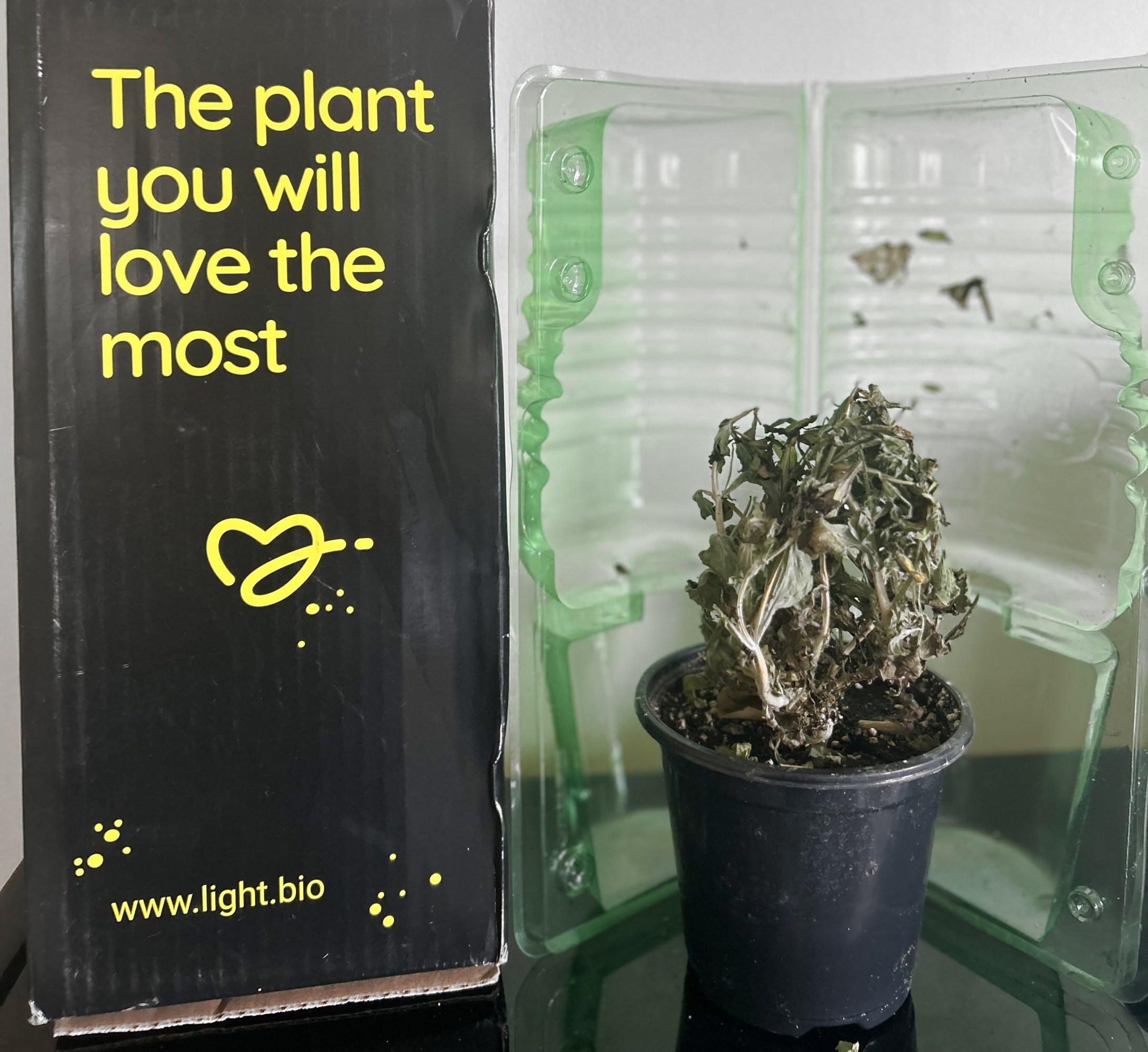
But when I unboxed my two petunias this week, they were in bad shape, with rotted leaves. And in a day, they were dead crisps. My first attempt to do biotech at home is a total bust, and it cost me $84, shipping included.
My plants did arrive in a handsome black box with neon lettering that alerted me to the living creature within. The petunias, about five inches tall, were each encased in a see-through plastic pod to keep them upright. Government warnings on the back of the box assured me they were free of Japanese beetles, sweet potato weevils, the snail Helix aspera, and gypsy moths.
The problem was when I opened the box. As it turns out, I left for a week’s vacation in Florida the same day that Light Bio, the startup selling the petunia, sent me an email saying “Glowing plants headed your way,” with a UPS tracking number. I didn’t see the email, and even if I had, I wasn’t there to receive them.
That meant my petunias sat in darkness for seven days. The box became their final sarcophagus.
My fault? Perhaps. But I had no idea when Light Bio would ship my order. And others have had similar experiences. Mat Honan, the editor in chief of MIT Technology Review, told me his petunia arrived the day his family flew to Japan. Luckily, a house sitter feeding his lizard eventually opened the box, and Mat reports the plant is still clinging to life in his yard.
But what about the glow? How strong is it?
Mat says so far, he doesn’t notice any light coming from the plant, even after carrying it into a pitch-dark bathroom. But buyers may have to wait a bit to see anything. It’s the flowers that glow most brightly, and you may need to tend your petunia for a couple of weeks before you get blooms and see the mysterious effect.
“I had two flowers when I opened mine, but sadly they dropped and I haven’t got to see the brightness yet. Hoping they will bloom again soon,” says Kelsey Wood, a postdoctoral researcher at the University of California, Davis.
She would like to use the plants in classes she teaches at the university. “It’s been a dream of synthetic biologists for so many years to make a bioluminescent plant,” she says. “But they couldn’t get it bright enough to see with the naked eye.”
Others are having success right out of the box. That’s the case with Tharin White, publisher of EYNTK.info, a website about theme parks. “It had a lot of protection around it and a booklet to explain what you needed to do to help it,” says White. “The glow is strong, if you are [in] total darkness. Just being in a dark room, you can’t really see it. That being said, I didn’t expect a crazy glow, so [it] meets my expectations.”
That’s no small recommendation coming from White, who has been a “cast member” at Disney parks and an operator of the park’s Avatar ride, named after the movie whose action takes place on a planet where the flora glows. “I feel we are leaps closer to Pandora—The World of Avatar being reality,” White posted to his X account.
Chronobiologist Brian Hodge also found success by resettling his petunia immediately into a larger eight-inch pot, giving it flower food and a good soaking, and putting it in the sunlight. “After a week or so it really started growing fast, and the buds started to show up around day 10. Their glow is about what I expected. It is nothing like a neon light but more of a soft gentle glow,” says Hodge, a staff scientist at the University of California, San Francisco.
In his daily work, Hodge has handled bioluminescent beings before—bacteria mostly—and says he always needed photomultiplier tubes to see anything. “My experience with bioluminescent cells is that the light they would produce was pretty hard to see with the naked eye,” he says. “So I was happy with the amount of light I was seeing from the plants. You really need to turn off all the lights for them to really pop out at you.”
Hodge posted a nifty snapshot of his petunia, but only after setting his iPhone for a two-second exposure.
Light Bio’s CEO Keith Wood didn’t respond to an email about how my plants died, but in an interview last month he told me sales of the biotech plant had been “viral” and that the company would probably run out of its initial supply. To generate new ones, it hires commercial greenhouses to place clippings in water, where they’ll sprout new roots after a couple of weeks. According to Wood, the plant is “a rare example where the benefits of GM technology are easily recognized and experienced by the public.”
Hodge says he got interested in the plants after reading an article about combating light pollution by using bioluminescent flora instead of streetlamps. As a biologist who studies how day and night affect life, he’s worried that city lights and computer screens are messing with natural cycles.
“I just couldn’t pass up being one of the first to own one,” says Hodge. “Once you flip the lights off, the glow is really beautiful … and it sorta feels like you are witnessing something out of a futuristic sci-fi movie!”
It makes me tempted to try again.
We’re not sure if rows of glowing plants can ever replace streetlights, but there’s no doubt light pollution is growing. Artificial light emissions on Earth grew by about 50% between 1992 and 2017—and as much as 400% in some regions. That’s according to Shel Evergreen,in his story on the switch to bright LED streetlights.
It’s taken a while for scientists to figure out how to make plants glow brightly enough to interest consumers. In 2016, I looked at a failed Kickstarter that promised glow-in-the-dark roses but couldn’t deliver.
Cassandra Willyard is updating us on the case of Lisa Pisano, a 54-year-old woman who is feeling “fantastic” two weeks after surgeons gave her a kidney from a genetically modified pig. It’s the latest in a series of extraordinary animal-to-human organ transplants—a technology, known as xenotransplantation, that may end the organ shortage.
Taiwan’s government is considering steps to ease restrictions on the use of IVF. The country has an ultra-low birth rate, but it bans surrogacy, limiting options for male couples. One Taiwanese pair spent $160,000 to have a child in the United States. (CNN)
Communities in Appalachia are starting to get settlement payments from synthetic-opioid makers like Johnson & Johnson, which along with other drug vendors will pay out $50 billion over several years. But the money, spread over thousands of jurisdictions, is “a feeble match for the scale of the problem.” (Wall Street Journal)
A startup called Climax Foods claims it has used artificial intelligence to formulate vegan cheese that tastes “smooth, rich, and velvety,” according to writer Andrew Rosenblum. He relates the results of his taste test in the new “Build” issue of MIT Technology Review. But one expert Rosenblum spoke to warns that computer-generated cheese is “significantly” overhyped.
AI hype continued this week in medicine when a startup claimed it has used “generative AI” to quickly discover new versions of CRISPR, the powerful gene-editing tool. But new gene-editing tricks won’t conquer the main obstacle, which is how to deliver these molecules where they’re needed in the bodies of patients. (New York Times).

Political fights over mining and minerals are heating up, and there are growing environmental and sociological concerns about how to source the materials the world needs to build new energy technologies.
But low-emissions energy sources, including wind, solar, and nuclear power, have a smaller mining footprint than coal and natural gas, according to a new report from the Breakthrough Institute released today.
The report’s findings add to a growing body of evidence that technologies used to address climate change will likely lead to a future with less mining than a world powered by fossil fuels. However, experts point out that oversight will be necessary to minimize harm from the mining needed to transition to lower-emission energy sources.
“In many ways, we talk so much about the mining of clean energy technologies, and we forget about the dirtiness of our current system,” says Seaver Wang, an author of the report and co-director of Climate and Energy at the Breakthrough Institute, an environmental research center.
In the new analysis, Wang and his colleagues considered the total mining footprint of different energy technologies, including the amount of material needed for these energy sources and the total amount of rock that needs to be moved to extract that material.
Many minerals appear in small concentrations in source rock, so the process of extracting them has a large footprint relative to the amount of final product. A mining operation would need to move about seven kilograms of rock to get one kilogram of aluminum, for instance. For copper, the ratio is much higher, at over 500 to one. Taking these ratios into account allows for a more direct comparison of the total mining required for different energy sources.
With this adjustment, it becomes clear that the energy source with the highest mining burden is coal. Generating one gigawatt-hour of electricity with coal requires 20 times the mining footprint as generating the same electricity with low-carbon power sources like wind and solar. Producing the same electricity with natural gas requires moving about twice as much rock.
Tallying up the amount of rock moved is an imperfect approximation of the potential environmental and sociological impact of mining related to different technologies, Wang says, but the report’s results allow researchers to draw some broad conclusions. One is that we’re on track for less mining in the future.
Other researchers have projected a decrease in mining accompanying a move to low-emissions energy sources. “We mine so many fossil fuels today that the sum of mining activities decreases even when we assume an incredibly rapid expansion of clean energy technologies,” Joey Nijnens, a consultant at Monitor Deloitte and author of another recent study on mining demand, said in an email.
That being said, potentially moving less rock around in the future “hardly means that society shouldn’t look for further opportunities to reduce mining impacts throughout the energy transition,” Wang says.
There’s already been progress in cutting down on the material required for technologies like wind and solar. Solar modules have gotten more efficient, so the same amount of material can yield more electricity generation. Recycling can help further cut material demand in the future, and it will be especially crucial to reduce the mining needed to build batteries.
Resource extraction may decrease overall, but it’s also likely to increase in some places as our demands change, researchers pointed out in a 2021 study. Between 32% and 40% of the mining increase in the future could occur in countries with weak, poor, or failing resource governance, where mining is more likely to harm the environment and may fail to benefit people living near the mining projects.
“We need to ensure that the energy transition is accompanied by responsible mining that benefits local communities,” Takuma Watari, a researcher at the National Institute for Environmental Studies and an author of the study, said via email. Otherwise, the shift to lower-emissions energy sources could lead to a reduction of carbon emissions in the Global North “at the expense of increasing socio-environmental risks in local mining areas, often in the Global South.”
Strong oversight and accountability are crucial to make sure that we can source minerals in a responsible way, Wang says: “We want a rapid energy transition, but we also want an energy transition that’s equitable.”
Are you looking for a camper that breaks away from the conventional teardrop design and blends functionality with sleek aesthetics? Meet the Kimberley Kube.
This innovative camper challenges the norms with its unique rectangular profile, flat roofline and vertical rear end.
By integrating the smooth composite construction of Kimberley's Kruiser line with the enclosed form of the Karavan, the Kube offers a compact yet surprisingly spacious design.
Whether you’re planning a weekend escape or a long adventure, the Kube brings a fresh perspective to teardrop campers, providing eye-catching design without sacrificing space or functionality.
MORE: BEST CAR ACCESSORIES 2024
True to Kimberley's heritage of robust, trail-ready caravans, the Kube is not just another pretty face. It’s built to tackle the harshest of terrains, equipped with a molded thermoplastic-composite body shell, a 100% recycled ArmaPET plastic floor and a sturdy hot-dipped galvanized steel chassis.
Complementing its tough build are 16-inch steel wheels, custom air springs, off-road racing mono-tube shocks and hydraulic override disc brakes, ensuring that it can handle even the most challenging off-road conditions.
MORE: DISCOVER THE FUTURE OF RVING WITH THE ELECTRIC TRANSFORMER HOUSE
Stepping inside the Kube, one is greeted by an interior that rivals a well-appointed hotel room. The trailer stretches 17 feet, providing ample space for a king-sized bed positioned within a mini-greenhouse setup that offers 270-degree views through three large windows and an additional skylight.
Storage is ingeniously integrated around and under the bed, ensuring that every inch of space is utilized. The front of the cabin includes a full-width console with storage solutions and an 85-L upright fridge/freezer, enhancing both convenience and comfort.
Kimberley understands that camping is about engaging with the outdoors. The Kube features a slide-out outdoor kitchen accessible from a hatch at the rear, equipped with a dual-burner stove, sink and dedicated prep area.
This kitchen setup allows for comfortable outdoor dining under the awning, facilitated further by a stainless steel breakfast table that attaches to the kitchen unit.
Additionally, the Kube offers the luxury of hot showers, thanks to a Webasto diesel water heater, with the option to add an ensuite shower/toilet tent for complete privacy.
25 CAMPING ESSENTIALS YOU NEED FOR VENTURING OUT INTO THE WOODS
MORE: 5 BEST PORTABLE CHARGERS
The Kube is prepared for any adventure with advanced technology integrations, such as a 200-Ah lithium battery, extensive LED lighting, optional solar charging and Starlink satellite internet prep.
The inclusion of modern comforts such as air conditioning, an onboard audio/video setup and the ability to stay connected via superfast 4G and GPS technology makes the Kube a standout in its class.
GET FOX BUSINESS ON THE GO BY CLICKING HERE
MORE: TOP TECH YOU NEED ON RV ROAD TRIPS
With prices starting at approximately $44,675, the Kimberley Kube offers a unique blend of luxury, functionality and ruggedness, making it an ideal choice for adventurers who refuse to compromise on comfort and style.
Whether exploring remote landscapes or enjoying a weekend getaway, the Kube promises an unmatched camping experience. It truly stands out as the "King of the Off-Road." It’s a trailblazing camper that promises both the thrill of the journey and the pleasures of home, wherever you may roam.
What additional features or customizations would you like to see in future models of the Kimberley Kube? Let us know by writing us at Cyberguy.com/Contact
For more of my tech tips & security alerts, subscribe to my free CyberGuy Report Newsletter by heading to Cyberguy.com/Newsletter
Ask Kurt a question or let us know what stories you'd like us to cover.
Answers to the most-asked CyberGuy questions:
Copyright 2024 CyberGuy.com. All rights reserved.