December 2023 - Tool Boxx

Sunday, December 31, 2023

Open Source Initiative co-founder imagines a post-open-source world

December 31, 2023 0

via TechSpot https://ift.tt/874RYM5
In a post-open-source world, Bruce Perens, one of the co-founders of the Open Source movement, envisions a simple compliance process that companies must go through every year in exchange for all the rights necessary to use open-source software. These companies would fund developers writing software for ordinary people as opposed...

Read Entire Article

How to protect your Android from a banking threat that bypasses fingerprint unlock and steals your PIN

December 31, 2023 0
How to protect your Android from a banking threat that bypasses fingerprint unlock and steals your PIN
https://ift.tt/PZjmsRz

You might think that using your fingerprint or face to unlock your phone is more secure than using your PIN. 

But you could be wrong. Hackers have developed sophisticated Android malware that can disable your biometric security and steal your PIN and data.

The malware is known as the Chameleon Android banking trojan. It was first detected earlier this year. The trojan can mimic legitimate apps and trick you into granting it permissions. Once it has access to your device, it can monitor your activity and intercept your credentials.

CLICK TO GET KURT’S FREE CYBERGUY NEWSLETTER WITH SECURITY ALERTS, QUICK VIDEO TIPS, TECH REVIEWS AND EASY HOW-TO’S TO MAKE YOU SMARTER

The malware can also bypass the security measure introduced in Android 13. This security measure, called the "restricted setting feature," allows you to control which apps can access certain settings and features on your device. This feature was supposed to prevent hackers from using the restricted setting feature to take over your device. According to BleepingComputer, the malware can use a clever technique to trick you into granting it permission to use the restricted setting feature without your consent. This means that the malware can control your device and even disable your fingerprint or face scan.

The malware can then display a fake lock screen and ask you to enter your PIN. If you do, the malware will capture your PIN and unlock your device. It can then access your banking apps and other sensitive information. It can also send money to the hackers’ accounts or purchase online goods without your knowledge.

This new and improved version of the Chameleon Android banking trojan will pop open an HTML page, asking your permission to change your accessibility settings. It will then abuse your accessibility features until your phone forces you to input your PIN.

You might not even notice it, either. Chameleon uses a platform called Zombinder to attach the malware to innocent apps. It can also schedule tasks. So once a hacker learns your schedule, they can run the trojan when your phone is normally inactive.

MORE: THIS STEALTHY ANDROID MALWARE CAN STEAL YOUR MONEY AND INVADE YOUR PRIVACY

1) The biggest way to protect yourself is only using legitimate app stores, like the Google Play Store, Amazon App Store, or Samsung Galaxy Store. Loading apps straight from the web, or sideloading, presents a ton of security risks. You usually can't see everything a file might contain, and it's easy for hackers to hide malware.

2) Google is constantly working on ways to mitigate threats like these. Make sure you're using the latest version of Android.

ELEMENTARY STUDENTS AT MINNESOTA SCHOOL EXPOSED TO PORN DURING SCHOOL ZOOM CALL

3) You should have good antivirus software installed. One of the most important steps to safeguard your Android from the Chameleon banking trojan and other malware is to install and update reliable antivirus software. Having good antivirus software actively running on your devices will alert you of any malware in your system, warn you against clicking on any malicious links in phishing emails and ultimately protect you from being hacked. Find my review of Best Antivirus Protection here.

If malware has already invaded your device, then you should take immediate action to minimize the damage and secure your device. Here are some steps you can follow:

MORE: BEWARE OF THESE POPULAR ANDROID APPS CONTAINING DECEPTIVE ADWARE

The Chameleon banking trojan can use a keylogger to record your passwords when you type them on your Android device. This can give hackers access to your online accounts and your personal or financial information. To prevent this, you should change your passwords for all your important accounts as soon as possible. However, you should not do this on your infected device, because the hacker might see your new passwords. Instead, you should use ANOTHER DEVICE, such as your laptop or desktop, to change your passwords. Make sure you use strong and unique passwords that are difficult to guess or break. You can also use a password manager to generate and store your passwords securely.

GET FOX BUSINESS ON THE GO BY CLICKING HERE

You should check your online accounts and transactions regularly for suspicious or unauthorized activity. If you notice anything unusual, report it to the service provider or the authorities as soon as possible. You should also review your credit reports and scores to see signs of identity theft or fraud.

The Chameleon banking trojan can capture everything you type on your Android device, including your personal and financial information. Hackers can use this information to create fake accounts in your name, access your existing accounts and pretend to be you online. This can cause serious damage to your identity and credit score.

To avoid this risk, you should use identity theft protection services. These services can track your personal information, such as your home title, Social Security Number (SSN), phone number and email address, and notify you if they detect any suspicious activity. They can also help you freeze your bank and credit card accounts to stop hackers from using them. Read more of my review of best identity theft protection services here. 

If hackers have obtained your bank or credit card information, they could use it to make purchases or withdrawals without your consent. You should contact your bank and credit card companies and inform them of the situation. They can help you freeze or cancel your cards, dispute any fraudulent charges and issue new cards for you.

If hackers have accessed your email or social media accounts, they could use them to send spam or phishing messages to your contacts. They could also impersonate you and ask for money or personal information. You should alert your contacts and warn them not to open or respond to any messages from you that seem suspicious or unusual.

If you want to make sure that your device is completely free of any malware or spyware, you can restore it to factory settings. This will erase all your data and settings and reinstall the original Android version. You should back up your important data before doing this, and only restore it from a trusted source.

MORE: 10 SIGNS YOUR IDENTITY HAS BEEN COMPROMISED

While threats like Chameleon banking malware attacks are scary, it's important to remember that you can protect yourself. Besides using official app stores, antivirus softwar, and the latest version of Android, you should also avoid downloading any apps that are not available on trusted platforms. Sideloading apps from unknown sources can expose your device to malware and hackers. You should never risk your Android security by sideloading apps.

Have you or someone you know encountered any issues with banking malware on your Android device? We're interested in hearing about your experiences and any precautions you've taken to safeguard your personal information. Share your story by writing us at Cyberguy.com/Contact.

For more of my tech tips and security alerts, subscribe to my free CyberGuy Report Newsletter by heading to Cyberguy.com/Newsletter

Ask Kurt a question or let us know what stories you'd like us to cover

Answers to the most asked CyberGuy questions:

Ideas for using those Holiday Gift cards

Copyright 2023 CyberGuy.com. All rights reserved.


from Technology News Articles on Fox News https://ift.tt/esyT8d9
via IFTTT

A 9-Month Cruise Is TikTok’s Favorite New ‘Reality Show’

December 31, 2023 0
A 9-Month Cruise Is TikTok’s Favorite New ‘Reality Show’
https://ift.tt/nNr4MiT
Social media users, gripped by the potential for drama on Royal Caribbean’s world cruise, have turned the ship’s unwitting passengers into “cast members” overnight.

from NYT > Technology https://ift.tt/tiy8rf7
via IFTTT

How Tracking and Technology in Cars Is Being Weaponized by Abusive Partners

December 31, 2023 0
How Tracking and Technology in Cars Is Being Weaponized by Abusive Partners
https://ift.tt/BrundhG
Apps that remotely track and control cars are being weaponized by abusive partners. Car manufacturers have been slow to respond, according to victims and experts.

from NYT > Technology https://ift.tt/vAx94Us
via IFTTT

Saturday, December 30, 2023

It’s not just for cops anymore — How this tiny body cam lets anyone record everything

December 30, 2023 0
It’s not just for cops anymore — How this tiny body cam lets anyone record everything
https://ift.tt/wG5tbUm

Body cameras are usually associated with law enforcement, but what if you could have one for yourself? 

Imagine being able to capture everything that happens around you and send a distress signal to your family or friends if you need help. 

That’s what PhoneCam, a tiny, affordable and smart AI-powered device, can do for you.

CLICK TO GET KURT’S FREE CYBERGUY NEWSLETTER WITH SECURITY ALERTS, QUICK VIDEO TIPS, TECH REVIEWS, AND EASY HOW-TO’S TO MAKE YOU SMARTER

PhoneCam is designed to help people feel safer in a world where personal safety fears are at a three-decade high in the U.S., according to a 2023 Gallup poll. It is smaller than a classic BIC lighter and weighs only 20 grams.

WHAT IS ARTIFICIAL INTELLIGENCE (AI)?

It comes with a magnet mount, which allows you to attach it to your clothes, backpack or bike. If needed, a jacket clip can be purchased as an extra accessory, which is intended for professional use.

PhoneCam connects to your smartphone and uses its microphone, CPU and connectivity (Wi-Fi, 4G/5G). It has an app that allows you to activate recording with a short press and instantly alert emergency contacts with a long press — providing additional security in critical situations.

You can also set up a pre-selected emergency contact who will receive an alarm call with your location and video feed.

MORE: CREEPY ROBOT DOGS BEING DEPLOYED TO PATROL NEIGHBORHOODS 

PhoneCam uses the phone's powerful CUP and, therefore, is able to run advanced AI. PhoneCam plans to incorporate other AI in the future to recognize faces, objects and scenes, and provide useful information and suggestions.

For example, PhoneCam will be able to detect if you are in a crowded or dangerous area and alert you to take precautions. PhoneCam will also be able to identify landmarks, artworks or products and give you relevant information or recommendations.

MORE: BEST TECH FOR PERSONAL PROTECTION

MORE: TOP PICKS TO AMP UP YOUR HOME SECURITY

PhoneCam has a free subscription plan that includes loop recording stored locally on your phone, and 20 minutes of alarms per month. You can also upgrade to a premium plan that offers cloud storage and more features.

PhoneCam is not just a personal safety device. It can also be used for various purposes, such as recording your adventures, documenting your work or monitoring your children or elders. PhoneCam has a control room app that allows you to see the location and status of other PhoneCam users in your group. You can also answer and forward alarms from other users.

CLICK HERE TO SIGN UP FOR OUR LIFESTYLE NEWSLETTER

MORE: SNEAKY LIGHTBULB SECURITY CAMERAS ARE THE NEXT BIG THING IN HOME SECURITY

PhoneCam says it adheres to the strictest data security and claims that it cannot access your stored videos and that your data will be stored locally on U.S. servers. As for privacy, the company says on its website that PhoneCam does not record without your activation.

PhoneCam was developed by SLIMDESIGN, a product design and development company. Its CEO and design director, Wouter Konings, says:

"Consumers and businesses have had limited access to a wearable camera that could help keep them safe — until now. We aimed to transform the way people perceive and utilize body cameras by introducing a compact, non-threatening alternative to the traditional model. PhoneCam’s sleek, lightweight design houses a powerful, AI-driven body camera, and the wide range of features keep users connected to resources that can help on short notice."

PhoneCam is expected to start production in 2024 and will be available for $69 on the company's website.

Owning a body camera is no longer just for law enforcement. The PhoneCam body camera offers a simple, smart and secure way to record everything that matters to you. With the tiny device, you can feel more confident, prepared and protected in any situation.

Do you think wearing a body camera like PhoneCam would make you feel safer and more secure? Let us know by writing us at Cyberguy.com/Contact

For more of my tech tips & security alerts, subscribe to my free CyberGuy Report Newsletter by heading to Cyberguy.com/Newsletter

Ask Kurt a question or let us know what stories you'd like us to cover.

Answers to the most asked CyberGuy questions:

Ideas for using those Holiday Gift cards

Copyright 2023 CyberGuy.com. All rights reserved.


from Technology News Articles on Fox News https://ift.tt/4zMHEDC
via IFTTT

An Artist in Residence on A.I.’s Territory

December 30, 2023 0
An Artist in Residence on A.I.’s Territory
https://ift.tt/K7wDRF5
Alexander Reben is taking his tech-savvy perspective to OpenAI, a company that some in the art world believe is a threat to their future.

from NYT > Technology https://ift.tt/t8fGYl7
via IFTTT

Friday, December 29, 2023

Researchers propose method to fight AirTag stalking while preserving privacy

December 29, 2023 0

via TechSpot https://ift.tt/9sODFK6
Researchers from Johns Hopkins University and the University of California have suggested a set of cryptographic tools that could counteract AirTag stalking better than Apple's current measures. The researchers believe that Apple's default anti-stalking features can compromise legitimate users' privacy.

Read Entire Article

Need a Home for 80,000 Puzzles? Try an Italian Castle.

December 29, 2023 0
Need a Home for 80,000 Puzzles? Try an Italian Castle.
https://ift.tt/DvVa6kp
Earlier this year, George and Roxanne Miller relocated the world’s largest collection of mechanical puzzles from their home in Florida. But first they took a road trip.

from NYT > Technology https://ift.tt/R5rkeGl
via IFTTT

How machine learning might unlock earthquake prediction

December 29, 2023 0

via MIT Technology Review https://ift.tt/NUhuVCe

In September 2017, about two minutes before a magnitude 8.2 earthquake struck Mexico City, blaring sirens alerted residents that a quake was coming. Such alerts, which are now available in the United States, Japan, Turkey, Italy, and Romania, among other countries, have changed the way we think about the threat of earthquakes. They no longer have to take us entirely by surprise.

Earthquake early warning systems can send alarms through phones or transmit a loud signal to affected regions three to five seconds after a potentially damaging earthquake begins. First, seismometers close to the fault pick up the beginnings of the quake, and finely programmed algorithms determine its probable size. If it is moderate or large, the resulting alert then travels faster than the earthquake itself, giving seconds to minutes of warning. This window of time is crucial: in these brief moments, people can shut off electricity and gas lines, move fire trucks into the streets, and find safe places to go. 

shot at night of buildings on fire
The magnitude 9 Tohoku-Oki earthquake of 2011 was preceded by two slow earthquakes.
AP IMAGES

But these systems have limitations. There are false positives and false negatives. What’s more, they react only to an earthquake that has already begun—we can’t predict an earthquake the way we can forecast the weather. And so many earthquake-­prone regions are left in a state of constant suspense. A proper forecast could let us do a lot more to manage risk, from shutting down the power grid to evacuating residents.

When I started my PhD in seismology in 2013, the very topic of earthquake prediction was deemed unserious, as outside the realm of mainstream research as the hunt for the Loch Ness Monster. 

But just seven years later, a lot had changed. When I began my second postdoc in 2020, I observed that scientists in the field had become much more open to earthquake prediction. The project I was a part of, Tectonic, was using machine learning to advance earthquake prediction. The European Research Council was sufficiently convinced of its potential to award it a four-year, €3.4 million grant that same year. 

Today, a number of well-respected scientists are getting serious about the prospect of prediction and are making progress in their respective subdisciplines. Some are studying a different kind of slow-motion behavior along fault lines, which could turn out to be a useful indicator that the devastating kind of earthquake we all know and fear is on the way. Others are hoping to tease out hints from other data—signals in seismic noise, animal behavior, and electromagnetism—to push earthquake science toward the possibility of issuing warnings before the shaking begins. 

In the dark

Earthquake physics can seem especially opaque. Astronomers can view the stars; biologists can observe an animal. But those of us who study earthquakes cannot see into the ground—at least not directly. Instead, we use proxies to understand what happens inside the Earth when its crust shakes: seismology, the study of the sound waves generated by movement within the interior; geodesy, the application of tools like GPS to measure how Earth’s surface changes over time; and paleoseismology, the study of relics of past earthquakes concealed in geologic layers of the landscape. 

Without good knowledge of what’s happening under the ground, it’s impossible to intuit any sense of order.

There is much we still don’t know. Decades after the theory of plate tectonics was widely accepted in the 1960s, our understanding of earthquake genesis hasn’t progressed far beyond the idea that stress builds to a critical threshold, at which point it is released through a quake. Different factors can make a fault more susceptible to reaching that point. The presence of fluids, for instance, is significant: the injection of wastewater fluid from oil and gas production has caused huge increases in tectonic activity across the central US in the last decade. But when it comes to knowing what is happening along a given fault line, we’re largely in the dark. We can construct an approximate map of a fault by using seismic waves and mapping earthquake locations, but we can’t directly measure the stress it is experiencing, nor can we quantify the threshold beyond which the ground will move.

For a long time, the best we could do regarding prediction was to get a sense of how often earthquakes happen in a particular region. For example, the last earthquake to rupture the entire length of the southern San Andreas Fault in California was in 1857. The average time period between big quakes there is estimated to be somewhere between 100 and 180 years. According to a back-of-the-envelope calculation, we could be “overdue.” But as the wide range suggests, recurrence intervals can vary wildly and may be misleading. The sample size is limited to the scope of human history and what we can still observe in the geologic record, which represents a small fraction of the earthquakes that have occurred over Earth’s history.

In 1985, scientists began installing seismometers and other earthquake monitoring equipment along the Parkfield section of the San Andreas Fault, in central California. Six earthquakes in that section had occurred at unusually regular intervals compared to earthquakes along other faults, so scientists from the US Geological Survey (USGS) forecasted with a high degree of confidence that the next earthquake of a similar magnitude would occur before 1993. The experiment is largely considered a failure—the earthquake didn’t come until 2004. 

Instances of regular intervals between earthquakes of similar magnitudes have been noted in other places, including Hawaii, but these are the exception, not the rule. Far more often, recurrence intervals are given as averages with large margins of error. For areas prone to large earthquakes, these intervals can be on the scale of hundreds of years, with uncertainty bars that also span hundreds of years. Clearly, this method of forecasting is far from an exact science. 

Tom Heaton, a geophysicist at Caltech and a former senior scientist at the USGS, is skeptical that we will ever be able to predict earthquakes. He treats them largely as stochastic processes, meaning we can attach probabilities to events, but we can’t forecast them with any accuracy. 

“In terms of physics, it’s a chaotic system,” Heaton says. Underlying it all is significant evidence that Earth’s behavior is ordered and deterministic. But without good knowledge of what’s happening under the ground, it’s impossible to intuit any sense of that order. “Sometimes when you say the word ‘chaos,’ people think [you] mean it’s a random system,” he says. “Chaotic means that it’s so complicated you cannot make predictions.” 

But as scientists’ understanding of what’s happening inside Earth’s crust evolves and their tools become more advanced, it’s not unreasonable to expect that their ability to make predictions will improve. 

Slow shakes

Given how little we can quantify about what’s going on in the planet’s interior, it makes sense that earthquake prediction has long seemed out of the question. But in the early 2000s, two discoveries began to open up the possibility. 

First, seismologists discovered a strange, low-amplitude seismic signal in a tectonic region of southwest Japan. It would last from hours up to several weeks and occurred at somewhat regular intervals; it wasn’t like anything they’d seen before. They called it tectonic tremor.

Meanwhile, geodesists studying the Cascadia subduction zone, a massive stretch off the coast of the US Pacific Northwest where one plate is diving under another, found evidence of times when part of the crust slowly moved in the opposite of its usual direction. This phenomenon, dubbed a slow slip event, happened in a thin section of Earth’s crust located beneath the zone that produces regular earthquakes, where higher temperatures and pressures have more impact on the behavior of the rocks and the way they interact.

The scientists studying Cascadia also observed the same sort of signal that had been found in Japan and determined that it was occurring at the same time and in the same place as these slow slip events. A new type of earthquake had been discovered. Like regular earthquakes, these transient events—slow earthquakes—redistribute stress in the crust, but they can take place over all kinds of time scales, from seconds to years. In some cases, as in Cascadia, they occur regularly, but in other areas they are isolated incidents.

Scientists subsequently found that during a slow earthquake, the risk of regular earthquakes can increase, particularly in subduction zones. The locked part of the fault that produces earthquakes is basically being stressed both by regular plate motion and by the irregular periodic backward motion produced by slow earthquakes, at depths greater than where earthquakes begin. These elusive slow events became the subject of my PhD research, but (as is often the case with graduate work) I certainly didn’t resolve the problem. To this day, it is unclear what exact mechanisms drive this kind of activity.

Could we nevertheless use slow earthquakes to predict regular earthquakes? Since their discovery, almost every big earthquake has been followed by several papers showing that it was preceded by a slow earthquake. The magnitude 9 Tohoku-Oki earthquake, which occurred in Japan in 2011, was preceded by not one but two slow ones. There are exceptions: for example, despite attempts to prove otherwise, there is still no evidence that a slow earthquake preceded the 2004 earthquake in Sumatra, Indonesia, which created a devastating tsunami that killed more than 200,000 people. What’s more, a slow earthquake is not always followed by a regular earthquake. It’s not known whether something distinguishes those that could be precursors from those that aren’t. 

It may be that some kind of distinctive process occurs along the fault in the hours leading up to a big quake. Last summer a former colleague of mine, Quentin Bletery, and his colleague Jean-Mathieu Nocquet, both at Géoazur, a multidisciplinary research lab in the south of France, published the results of an analysis of data on crustal deformation in the hours leading up to 90 larger earthquakes. They found that in the two hours or so preceding an earthquake, the crust along the fault begins to deform at a faster rate in the direction of the earthquake rupture until the instant the quake begins. What this tells us, Bletery says, is that an acceleration process occurs along the fault ahead of the motion of the earthquake—something that resembles a slow earthquake.

“This does support the assumption that there’s something happening before. So we do have that,” he says. “But most likely, it’s not physically possible to play with the topic of prediction. We just don’t have the instruments.” In other words, the precursors may be there, but we’re currently unable to measure their presence well enough to single them out before an earthquake strikes. 

Bletery and Nocquet conducted their study using traditional statistical analysis of GPS data; such data might contain information that’s beyond the reach of our traditional models and frames of reference. Seismologists are now applying machine learning in ways they haven’t before. Though it is early days yet, the machine-learning approach could reveal hidden structures and causal links in what would otherwise look like a jumble of data. 

Finding signals in the noise

Earthquake researchers have applied machine learning in a variety of ways. Some, like Mostafa Mousavi and Gregory Beroza of Stanford, have studied how to use it on seismic data from a single seismic station to predict the magnitude of an earthquake, which can be tremendously useful for early warning systems and may also help clarify what factors determine an earthquake’s size.

Brendan Meade, a professor of earth and planetary science at Harvard, is able to predict the locations of aftershocks using neural networks. Zachary Ross at Caltech and others are using deep learning to pick seismic waves out of data even with high levels of background noise, which could lead to the detection of more earthquakes.

Paul Johnson of the Los Alamos National Laboratory in New Mexico, who became something between a mentor and a friend after we met during my first postdoc, is applying machine learning to help make sense of data from earthquakes generated in the lab. 

There are a number of ways to create laboratory earthquakes. One relatively common method involves placing a rock sample, cut down the center to simulate a fault, inside a metal framework that puts it under a confining pressure. Localized sensors measure what happens as the sample undergoes deformation.  

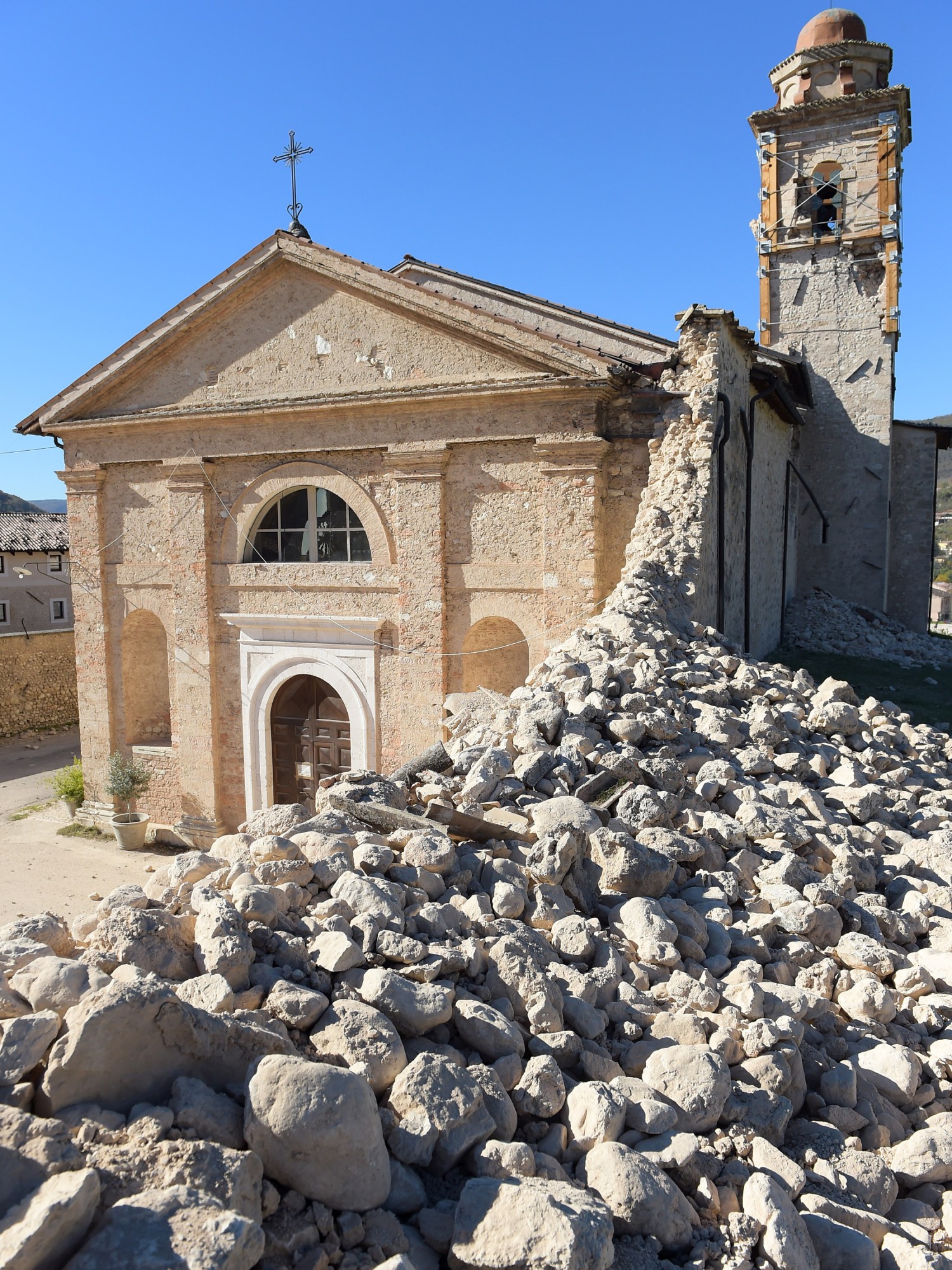
an old church seen standing past a massive pile of rubble in the foreground
In Italy, increased agitation among animals was linked to strong earthquakes, including the deadly Norcia quake in 2016.
SIPA USA VIA AP

In 2017, a study out of Johnson’s lab showed that machine learning could help predict with remarkable accuracy how long it would take for the fault the researchers created to start quaking. Unlike many methods humans use to forecast earthquakes, this one uses no historical data—it relies only on the vibrations coming from the fault. Crucially, what human researchers had discounted as low-­amplitude noise turned out to be the signal that allowed machine learning to make its predictions. 

In the field, Johnson’s team applied these findings to seismic data from Cascadia, where they identified a continuous acoustic signal coming from the subduction zone that corresponds to the rate at which that fault is moving through the slow earthquake cycle—a new source of data for models of the region. “[Machine learning] allows you to make these correlations you didn’t know existed. And in fact, some of them are remarkably surprising,” Johnson says. 

Machine learning could also help us create more data to study. By identifying perhaps as many as 10 times more earthquakes in seismic data than we are aware of, Beroza, Mousavi, and Margarita Segou, a researcher at the British Geological Survey, determined that machine learning is useful for creating more robust databases of earthquakes that have occurred; they published their findings in a 2021 paper for Nature Communications. These improved data sets can help us—and machines—understand earthquakes better.

“You know, there’s tremendous skepticism in our community, with good reason,” Johnson says. “But I think this is allowing us to see and analyze data and realize what those data contain in ways we never could have imagined.”

Animal senses

While some researchers are relying on the most current technology, others are looking back at history to formulate some pretty radical studies based on animals. One of the shirts I collected over 10 years of attending geophysics conferences features the namazu, a giant mythical catfish that in Japan was believed to generate earthquakes by swimming beneath Earth’s crust. 

The creature is seismology’s unofficial mascot. Prior to the 1855 Edo earthquake in Japan, a fisherman recorded some atypical catfish activity in a river. In a 1933 paper published in Nature, two Japanese seismologists reported that catfish in enclosed glass chambers behaved with increasing agitation before earthquakes—a phenomenon said to predict them with 80% accuracy. 

The closer the animals were to the earthquake’s source, the more advance warning their seemingly panicked behavior could provide.

Catfish are not the only ones. Records dating back as early as 373 BCE show that many species, including rats and snakes, left a Greek city days before it was destroyed by an earthquake. Reports noted that horses cried and some fled San Francisco in the early morning hours before the 1906 earthquake.

Martin Wikelski, a research director at the Max Planck Institute of Animal Behavior, and his colleagues have been studying the possibility of using the behavior of domesticated animals to help predict earthquakes. In 2016 and 2017 in central Italy, the team attached motion detectors to dogs, cows, and sheep. They determined a baseline level of movement and set a threshold for what would indicate agitated behavior: a 140% increase in motion relative to the baseline for periods lasting longer than 45 minutes. They found that the animals became agitated before eight of nine earthquakes greater than a magnitude 4, including the deadly magnitude 6.6 Norcia earthquake of 2016. And there were no false positives—no times when the animals were agitated and an earthquake did not occur. They also found that the closer the animals were to the earthquake’s source, the more advance warning their seemingly panicked behavior could provide.

Wikelski has a hypothesis about this phenomenon: “My take on the whole thing would be that it could be something that’s airborne, and the only thing that I can think of is really the ionized [electrically charged] particles in the air.”

Electromagnetism isn’t an outlandish theory. Earthquake lights—glowing emissions from a fault that resemble the aurora borealis—have been observed during or before numerous earthquakes, including the 2008 Sichuan earthquake in China, the 2009 L’Aquila earthquake in Italy, the 2017 Mexico City earthquake, and even the September 2023 earthquake in Morocco

Friedemann Freund, a scientist at NASA’s Ames Research Center, has been studying these lights for decades and attributes them to electrical charges that are activated by motion along the fault in certain types of rocks, such as gabbros and basalts. It is akin to rubbing your sock on the carpet and freeing up electrons that allow you to shock someone. 

Some researchers have proposed different mechanisms, while others discount the idea that earthquake lights are in any way related to earthquakes. Unfortunately, measuring electromagnetic fields in Earth’s crust or surface is not straightforward. We don’t have instruments that can sample large areas of an electromagnetic field. Without knowing in advance where an earthquake will be, it is challenging, if not impossible, to know where to install instruments to make measurements. 

At present, the most effective way to measure such fields in the ground is to set up probes where there is consistent groundwater flow. Some work has been done to look for electromagnetic and ionospheric disturbances caused by seismic and pre-seismic activity in satellite data, though the research is still at a very early stage.

Small movements

Some of science’s biggest paradigm shifts started without any understanding of an underlying mechanism. The idea that continents move, for example—the basic phenomenon at the heart of plate tectonics—was proposed by Alfred Wegener in 1912. His theory was based primarily on the observation that the coastlines of Africa and South America match, as if they would fit together like puzzle pieces. But it was hotly contested. He was missing an essential ingredient that is baked into the ethos of modern science—the why. It wasn’t until the 1960s that the theory of plate tectonics was formalized, after evidence was found of Earth’s crust being created and destroyed, and at last the mechanics of the phenomenon were understood. 

In all those years in between, a growing number of people looked at the problem from different angles. The paradigm was shifting. Wegener had set the wheels of change in motion.

Perhaps that same sort of shift is happening now with earthquake prediction. It may be decades before we can look back on this period in earthquake research with certainty and understand its role in advancing the field. But some, like Johnson, are hopeful. “I do think it could be the beginning of something like the plate tectonics revolution,” he says. “We might be seeing something similar.” 

Allie Hutchison is a writer based in Porto, Portugal.

Thursday, December 28, 2023

The EEC might have leaked unannounced RDNA 3 graphics cards

December 28, 2023 0

via TechSpot https://ift.tt/h9qDnPz
Recent listings from the Eurasian Economic Commission (EEC) indicate that some AMD GPU partners are preparing to release graphics cards that the company hasn't yet announced. They mainly occupy performance profiles between RDNA 3's current mid-range and entry-level products.

Read Entire Article

We need a moonshot for computing

December 28, 2023 0

via MIT Technology Review https://ift.tt/nomCLZ8

In its final weeks, the Obama administration released a report that rippled through the federal science and technology community. Titled Ensuring Long-Term US Leadership in Semiconductors, it warned that as conventional ways of building chips brushed up against the laws of physics, the United States was at risk of losing its edge in the chip industry. Five and a half years later, in 2022, Congress and the White House collaborated to address that possibility by passing the CHIPS and Science Act—a bold venture patterned after the Manhattan Project, the Apollo program, and the Human Genome Project. Over the course of three administrations, the US government has begun to organize itself for the next era of computing.

Secretary of Commerce Gina Raimondo has gone so far as to directly compare the passage of CHIPS to President John F. Kennedy’s 1961 call to land a man on the moon. In doing so, she was evoking a US tradition of organizing the national innovation ecosystem to meet an audacious technological objective—one that the private sector alone could not reach. Before JFK’s announcement, there were organizational challenges and disagreement over the best path forward to ensure national competitiveness in space. Such is the pattern of technological ambitions left to their own timelines. 

Setting national policy for technological development involves making trade-offs and grappling with unknown future issues. How does a government account for technological uncertainty? What will the nature of its interaction with the private sector be? And does it make more sense to focus on boosting competitiveness in the near term or to place big bets on potential breakthroughs? 

The CHIPS and Science Act designated $39 billion for bringing chip factories, or “fabs,” and their key suppliers back to the United States, with an additional $11 billion committed to microelectronics R&D. At the center of the R&D program would be the National Semiconductor Technology Center, or NSTC—envisioned as a national “center of excellence” that would bring the best of the innovation ecosystem together to invent the next generation of microelectronics.  

In the year and a half since, CHIPS programs and offices have been stood up, and chip fabrication facilities in Arizona, Texas, and Ohio have broken ground. But it is the CHIPS R&D program that has an opportunity to shape the future of the field. Ultimately, there is a choice to make in terms of national R&D goals: the US can adopt a conservative strategy that aims to preserve its lead for the next five years, or it can orient itself toward genuine computing moonshots. The way the NSTC is organized, and the technology programs it chooses to pursue, will determine whether the United States plays it safe or goes “all in.” 

Welcome to the day of reckoning

In 1965, the late Intel founder Gordon Moore famously predicted that the path forward for computing involved cramming more transistors, or tiny switches, onto flat silicon wafers. Extrapolating from the birth of the integrated circuit seven years earlier, Moore forecast that transistor count would double regularly while the cost per transistor fell. But Moore was not merely making a prediction. He was also prescribing a technological strategy (sometimes called “transistor scaling”): shrink transistors and pack them closer and closer together, and chips become faster and cheaper. This approach not only led to the rise of a $600 billion semiconductor industry but ushered the world into the digital age. 

Ever insightful, Moore did not expect that transistor scaling would last forever. He referred to the point when this miniaturization process would reach its physical limits as the “day of reckoning.” The chip industry is now very close to reaching that day, if it is not there already. Costs are skyrocketing and technical challenges are mounting. Industry road maps suggest that we may have only about 10 to 15 years before transistor scaling reaches its physical limits—and it may stop being profitable even before that. 

To keep chips advancing in the near term, the semiconductor industry has adopted a two-part strategy. On the one hand, it is building “accelerator” chips tailored for specific applications (such as AI inference and training) to speed computation. On the other, firms are building hardware from smaller functional components—called “chiplets”—to reduce costs and improve customizability. These chiplets can be arranged side by side or stacked on top of one another. The 3D approach could be an especially powerful means of improving speeds. 

This two-part strategy will help over the next 10 years or so, but it has long-term limits. For one thing, it continues to rely on the same transistor-building method that is currently reaching the end of the line. And even with 3D integration, we will continue to grapple with energy-hungry communication bottlenecks. It is unclear how long this approach will enable chipmakers to produce cheaper and more capable computers.  

Building an institutional home for moonshots

The clear alternative is to develop alternatives to conventional computing. There is no shortage of candidates, including quantum computing; neuromorphic computing, which mimics the operation of the brain in hardware; and reversible computing, which has the potential to push the energy efficiency of computing to its physical limits. And there are plenty of novel materials and devices that could be used to build future computers, such as silicon photonics, magnetic materials,and superconductor electronics. These possibilities could even be combined to form hybrid computing systems.

None of these potential technologies are new: researchers have been working on them for many years, and quantum computing is certainly making progress in the private sector. But only Washington brings the convening power and R&D dollars to help these novel systems achieve scale. Traditionally, breakthroughs in microelectronics have emerged piecemeal, but realizing new approaches to computation requires building an entirely new computing “stack”—from the hardware level up to the algorithms and software. This requires an approach that can rally the entire innovation ecosystem around clear objectives to tackle multiple technical problems in tandem and provide the kind of support needed to “de-risk” otherwise risky ventures.

Does it make more sense to focus on boosting competitiveness in the near term or to place big bets on potential breakthroughs?

The NSTC can drive these efforts. To be successful, it would do well to follow DARPA’s lead by focusing on moonshot programs. Its research program will need to be insulated from outside pressures. It also needs to foster visionaries, including program managers from industry and academia, and back them with a large in-house technical staff. 

The center’s investment fund also needs to be thoughtfully managed, drawing on best practices from existing blue-chip deep-tech investment funds, such as ensuring transparency through due-diligence practices and offering entrepreneurs access to tools, facilities, and training. 

It is still early days for the NSTC: the road to success may be long and winding. But this is a crucial moment for US leadership in computing and microelectronics. As we chart the path forward for the NSTC and other R&D priorities, we’ll need to think critically about what kinds of institutions we’ll need to get us there. We may not get another chance to get it right.

Brady Helwig is an associate director for economy and PJ Maykish is a senior advisor at the Special Competitive Studies Project, a private foundation focused on making recommendations to strengthen long-term US competitiveness.

A.I. Can Make Art That Feels Human. Whose Fault Is That?

December 28, 2023 0
A.I. Can Make Art That Feels Human. Whose Fault Is That?
https://ift.tt/2t6UWhc
A fake Drake/Weeknd mash-up is not a threat to our species’s culture. It’s a warning: We can’t let our imaginations shrink to machine size.

from NYT > Technology https://ift.tt/ljNkd0v
via IFTTT

Wednesday, December 27, 2023

Chinese Spy Agency Rising to Challenge the C.I.A.

December 27, 2023 0
Chinese Spy Agency Rising to Challenge the C.I.A.
https://ift.tt/oB9venV
The ambitious Ministry of State Security is deploying A.I. and other advanced technology to go toe-to-toe with the United States, even as the two nations try to pilfer each other’s trade secrets.

from NYT > Technology https://ift.tt/odTrlgB
via IFTTT

Amazon Prime Video will introduce ads to its movies and TV shows starting January 29

December 27, 2023 0

via TechSpot https://ift.tt/w4peUxK
Back in September, Amazon made the unwelcome announcement that ads would be coming to the video streaming element of its $14.99 per month/$139 per year Prime service. They will also be part of the $9 per month standalone Prime Video membership plan.

Read Entire Article

Six takeaways from a climate-tech boom

December 27, 2023 0

via MIT Technology Review https://ift.tt/7KWiIht

The surge of climate-tech startups seeking to reinvent clean energy and transform huge industrial markets is fueling optimism about our prospects for addressing climate change. Tens of billions are pouring into these venture-backed companies in just about every field you can imagine, from green steel to nuclear fusion.

As I explain in “Climate tech is back—and this time, it can’t afford to fail,” investments led by venture capitalists could play a critical role in developing novel sources of clean energy and greener industrial processes. Speaking to numerous VCs, people at startups, and those academics who study innovation in so-called deep tech, I became convinced we’re in the early stages of a carbon-free economy. 

But the optimism comes with a warning. As a journalist who wrote extensively about cleantech 1.0, which began around 2006 and collapsed by 2013 as countless solar, battery, and biofuel firms failed, I have a sense of wariness. All of it feels a bit too familiar: the exuberance of the VCs, the hundred of millions going to risky demonstration plants testing unproven technologies, and the potential political backlash over government support of aggressive climate policies. Writing about the current climate-tech boom means keeping in mind that most previous venture-backed startups in cleantech have failed miserably.

Today’s investors and entrepreneurs hope this time is different. As I discovered in speaking with them, there are plenty of reasons they might be right; there is far more money available, and far more demand for cleaner products from consumers and industrial customers. Yet many of the challenges seen in the first boom still exist and provide ample reason to worry about the success of today’s climate-tech startups.

Here are some of the key lessons from cleantech 1.0. To learn more, you can read my full report here

six die with the facing sides arranged in a line from one to six.

Lesson #1: Demand matters. This is basic to any market but is oft ignored in climate tech: someone needs to want to buy your product. Despite the public and scientific concerns over climate change, it’s a tough sell to get people and companies to pay extra for, say, green concrete or clean electricity.

A recent study by David Popp at Syracuse University and his colleague Matthias van den Heuvel suggests that weak demand, more than the costs and risks associated with scaling up startups, was what doomed the first cleantech wave. 

Many of the products in cleantech are commodities; price often matters above all else, and green products, especially when they are first introduced, are typically too expensive to compete. The argument helps to explain the great exception to the cleantech 1.0 bust: Tesla Motors. “Tesla’s been able to differentiate their product: the brand itself has value,” says Popp. But, he adds, “it’s hard to imagine that there’s going to be a trendy [green] hydrogen brand.”  

The findings suggest that government policies are probably most effective when they help to create demand for, say, green hydrogen or cement rather than directly funding startups as they struggle toward commercialization. 

Lesson #2: Hubris hurts. One of the most obvious problems in cleantech 1.0 was the extreme hubris of many of its advocates. Leading cheerleaders and money men (yes, nearly all were men) had made their fortunes on computers, software, and the web and sought to apply the same strategies to cleantech.

“Rule number one: do not have people invest in a category who do not know about the category,” says Matthew Nordan, general partner at Azolla Ventures. “Cleantech 1.0 investors were largely folks from tech and biotech, desperately trying to come up to speed on industrial categories they knew little about.”

These days many venture capitalists profess to be chastened by the experience of cleantech 1.0 and deeply ingrained in the industries they hope to disrupt. But there are still some high-profile investors parachuting in from making fortunes in Big Tech who are convinced they have the solution to the world’s biggest problem.  

I asked Josh Lerner, a professor at Harvard Business School who studies how venture capital works, why such investors haven’t learned from the past. The pessimistic view, he says, “is that these guys are just megalomaniac characters who want to save the world and view themselves as heroes, and they’re just fools plunging again even though they had their head handed to them before.” A more optimistic view, he says, is that they might be able “to take some of the knowledge and innovations that happened in the software arena and put them to work here.”

Lesson #3: Molecules are different from bits. Yes, of course, we know writing code is easier and cheaper than building a steel plant. But just how much riskier and unpredictable it is to scale up molecule-based businesses was an unpleasant surprise to many during cleantech 1.0. Poor yields or the synthesis of unwanted by-products—problems that might have seemed like small hiccups in the lab—can be show stoppers as the process is scaled up and must compete against existing technologies.

Finding out whether a process is commercially competitive typically means building a demonstration plant, often costing $100 million or more. Many startups during cleantech 1.0 got tripped up when processes that worked fine in the lab didn’t work nearly as well in larger facilities. You just don’t know if an industrial process will work until you build it.

The hope these days is that far more computation power and the use of artificial intelligence will allow startups to simulate how processes will work before actually building anything. Running a new way to make green hydrogen in silico to see what goes wrong is certainly far cheaper and safer than building a $100 million demonstration plant.

Lesson #4: The real takeaway from Solyndra. The failure of the company, which received a $535 million loan guarantee from the US government to manufacture a novel type of solar panel, is the one that everyone remembers from cleantech 1.0. And it’s often offered as strong evidence of what goes wrong when governments try to pick winners. But the lingering lesson from the failure of Solyndra is quite different.

First—whether you’re in government or a venture capitalist—don’t invest in technology that makes little manufacturing sense and has dubious market demand. Solyndra’s product was a highly complex cylinder-shaped solar panel that required custom and unproven equipment to build. 

See lessons #1, #2, and #3. I wrote this in 2011: “What Solyndra lacked, though, was market savvy and manufacturing flexibility. Although the company had quickly traversed what Silicon Valley’s entrepreneurs like to call ‘the valley of death’—the risky financial period between receiving initial venture funding and beginning to earn revenues—it badly faltered in turning its operations into a viable, long-term business. If there is a prevailing lesson from the Solyndra debacle, it has to do with the danger of trying to do too much too quickly—and doing it alone.”

Solyndra would likely have failed anyway, but had the company gone slower, a lot of people, including both US taxpayers and the VCs who ponied up hundreds of millions, would have lost a lot less money.

Lesson #5: Politics can change everything. The 2022 Inflation Reduction Act, which helped fuel the recent wave of cleantech investments, passed Congress without a single Republican vote. Simply put, electing a Republican president in 2024 could mean an end to the aggressive federal climate policies.

And there is an ongoing backlash in many other industrial countries. Recently in the UK, the prime minister proposed weakening the country’s climate policies. Even Germany is showing signs of backing away from political support and funding for cleantech. 

In his recent paper, Syracuse’s Popp and his coauthor traced the woes of cleantech 1.0 back to a largely forgotten Senate election in early 2010. After the death of the liberal Democrat Ted Kennedy, Massachusetts voters elected the Republican Scott Brown, dooming a comprehensive climate bill being debated in Congress. Without the possibility of carbon pricing, many venture investors lost interest in clean-energy startups. 

By the end of the year, a newly elected Republican majority in the US House of Representatives had doomed additional large federal investments in clean energy.

Politics do matter. And they can change overnight.

Lesson #6: Survival is all about the economics. The early days of cleantech 1.0 were filled with enthusiasm and good intentions. People saw climate change as an existential crisis, and technology, led by visionary entrepreneurs and venture capitalists, was going to solve it. The vibes these days are in many ways similar; in fact, people are even more intense and committed. The brilliance of many new climate technologies is evident, and we desperately need them.

But none of that will ensure success. Venture-backed startups will need to survive on the basis of economics and financial advantages, not good intentions. 

The simple fact is that we have too few examples of prosperous climate-tech startups with radical new technology. It’s all still a grand experiment. Cleantech 1.0 taught us what can go wrong. We’re still learning how to get it right.

A high-tech mouthguard that might help prevent concussions

December 27, 2023 0

via MIT Technology Review https://ift.tt/Yw4b05F

When athletes or soldiers have a concussion, the most beneficial course of action is to simply get them off the playing field or out of the action so they can recover. Yet much about head injuries remains a mystery, including the reasons why some impacts result in concussion while others don’t.

But new measuring devices are being developed that could help deliver a wealth of information about head impacts. By giving an immediate warning that a person needs to be removed from action or play, they could help protect soldiers and athletes alike from brain damage. 

Appreciation of the real risks of head injuries has been a long time coming. “Even 10 years ago, if someone took a big hit they were told to get up and play or keep going,” says Mike Shogren, CEO of Prevent Biometrics. “Now reducing major head impacts and understanding concussion risk is a major focus in sports and the military.”

Prevent is one of several companies developing new sensors to precisely measure and record head impacts, which would help identify possible concussions and provide data for studies of cumulative effects. 

Scientists have been trying to measure the forces involved in head trauma for a long time, says Adam Bartsch, the company’s chief science officer. “Decades ago, scientists had to use Rube Goldberg contraptions to study head impact,” he says. “Sometimes these were made from a dental mold with a rigid plate and sensors bigger than dice, with a 10-meter-long cable connecting it to a computer. The wearer would drool and the data wasn’t perfect, but it was the best they had.”

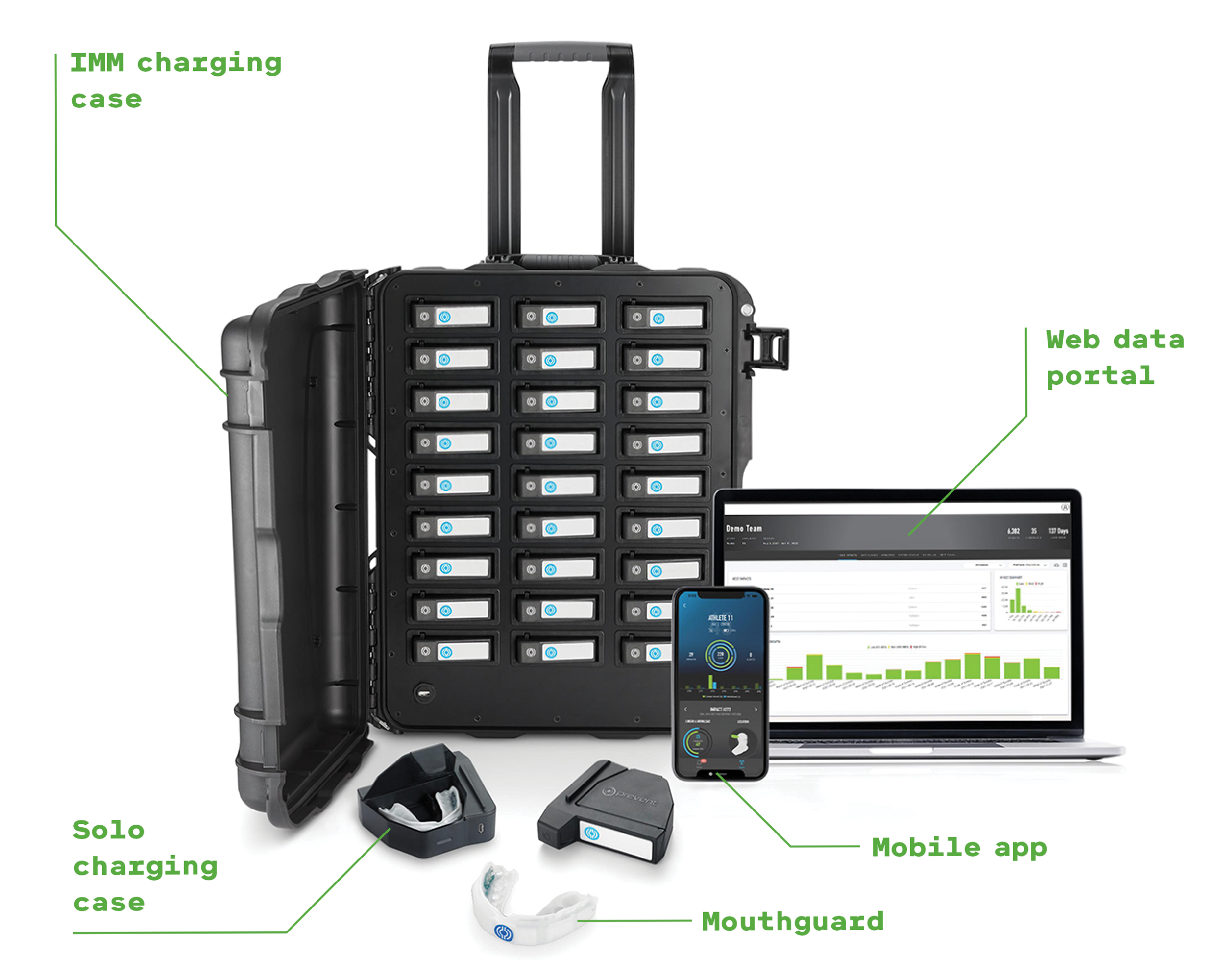
First conceived at the Cleveland Clinic, Prevent’s device, the Impact Monitoring Mouthguard (IMM), fits into the wearer’s mouth, working as both a monitoring tool and a functional mouthguard. It calculates the force, location, direction, and number of impacts and can then transmit data via Bluetooth to other devices for assessment. 

Prevent is using the IMM to study parachute landing falls (or PLFs), a landing technique that was developed by the United States Army as part of its paratrooper training program, using over 2,000 paratroopers as subjects. A correctly executed PLF absorbs the shock of hitting the ground as the parachutist lands feet first and falls sideways, successively distributing the landing shock along the calves, thighs, hips, and back. But an error can whip the parachutist’s head backwards and onto the ground. The IMM’s sensors revealed that this occurs far more often than anyone realized. 

a product family shot showing the IMM charging case, mouthguard, mobile app on phone, web data portal on laptop and the solo charging case
PREVENT BIOMETRICS

“We found a significant head impact in about 5% of jumps,” says Bartsch. “That’s about 30 times as much as the published incidence of concussion in paratroopers.” A battery of tests confirmed that the events the mouthguard registered as possibly causing concussions had in fact done so. Paratroopers tend to just get up and carry on after a bad landing, so the official figures had previously reflected only the injuries of those who were physically unable to get up on their own. 

In sports, similarly, athletes are often encouraged to “get over it” rather than report an injury. Prevent is carrying out a large-scale project with World Rugby, which will monitor players and allow coaches to take injured players off the field and have them assessed. (Several other instrumented mouthguards—the Biocore, the ORB, and HitIQ—are being developed for other sports, including boxing and lacrosse.) In the future, Prevent hopes to be able to evaluate the total effect of lots of smaller shocks to see under what circumstances they cause serious cumulative injury. “Understanding total exposure on top of just major impacts is also critical,” Shogren says. “It’s like in a boxing match. The impact that knocks you out at the end might not have knocked you out on its own in the first round.”

David Hambling is a technology journalist based in South London.

Tuesday, December 26, 2023

Rockstar Games faces another leak as GTA V source code, GTA VI and Bully 2 details appear online

December 26, 2023 0

via TechSpot https://ift.tt/hiAb6gZ
The full extent of the leak is not yet known, with several X users posting screenshots and claims. It's believed that a link to a 4GB file containing GTA V code was posted, but it's unclear if a complete version of the game's entire source code, rumored to be around...

Read Entire Article

The mistake slowing down your connection and killing your phone

December 26, 2023 0
The mistake slowing down your connection and killing your phone
https://ift.tt/7bEKVrg

It’s a cozy evening, and you just started streaming your favorite show. But, as the plot thickens, your Wi-Fi takes an unexpected hiatus. Annoying, right?

Before you unplug your router, look at your smartphone. The culprit could be apps chowing down on precious bandwidth.

Only days left to win a new iPhone 15 (a $799 value)! Enter to win now!

SHOPPING UNDER SURVEILLANCE: HOW RETAILERS TRACK YOU & HOW TO BE INVISIBLE

What’s the big deal?

You’ve probably seen notifications you’re using too much data. Besides getting charged more, why does it really matter? Glad you asked.

How to check 

Now, let's get down to the nitty-gritty of how to detect those sneaky Wi-Fi bandits on your Android or iPhone.

For Android

As I'm constantly reminded, steps vary depending on your phone. If that doesn't work, search your settings for Wi-Fi or Data.

You'll see each app and how much bandwidth it’s used over the last month. Android lets you go up to four months back for an even more detailed overview. Select the dates at the top of the screen, and voila!

EVERYDAY TECH HACKS: FROM PHONE SHORTCUTS TO WEBCAM MAGIC

For iPhone

While iOS doesn't have a built-in feature to track Wi-Fi usage, there's a workaround. You can monitor your mobile data usage for a glance as to which apps are most bandwidth-intensive.

You may not use heavier social networking apps or entertainment platforms while on your mobile data, so these might be hidden further below. Spotify, YouTube and Netflix are some of the main culprits!

What to do about it
 

Of course, you know to close the hungriest apps if they're not in use and eating up too much bandwidth. There's more you can do, too:

While you’re at it, do an app audit

Scroll through your apps and note which ones you rarely use or don’t use. Do you have two or three apps that perform the same function? How about the one you downloaded for a free trial membership years ago?

Your iPhone can help if you’re not sure where to start. To get a detailed view of your app activity and what you use most, go to Settings > Screen Time and select See All Activity

If you’re on an Android, tap Settings > Digital Wellbeing & parental controls > Dashboard to view screen times for each app. 

My advice: Trim the fat. Your devices work better when they run lean.

Keep your tech-know going 

My popular podcast is called "Kim Komando Today." It’s a solid 30 minutes of tech news, tips, and callers with tech questions like you from all over the country. Search for it wherever you get your podcasts. For your convenience, hit the link below for a recent episode.

PODCAST PICK: 5-star review bullying, fake AI boyfriends & 10 tech myths

Plus, Dr. Ben Goertzel from Prophets of AI created Sophia, the world’s most famous robot. He tells us more about artificial general intelligence — the AI that thinks like humans do. There's more: GM says goodbye to Apple CarPlay and surveillance tech to stop drunk drivers. 

Check out my podcast "Kim Komando Today" on Apple, Google Podcasts, Spotify, or your favorite podcast player.

Listen to the podcast here or wherever you get your podcasts. Just search for my last name, "Komando."

Sound like a tech pro, even if you’re not! Award-winning popular host Kim Komando is your secret weapon. Listen on 425+ radio stations or get the podcast. And join over 400,000 people who get her free 5-minute daily email newsletter.

CLICK HERE TO GET THE FOX NEWS APP

Copyright 2024, WestStar Multimedia Entertainment. All rights reserved.


from Technology News Articles on Fox News https://ift.tt/VrKUMXi
via IFTTT

Meet the economist who wants the field to account for nature

December 26, 2023 0

via MIT Technology Review https://ift.tt/2W4kgfU

What is the true value of a honeybee? A mountain stream? A mangrove tree? 

Gretchen Daily, cofounder and faculty director of the Stanford Natural Capital Project, has dedicated her career to answering such complex questions. Using emerging scientific data and the project’s innovative open-source software, Daily and her team help governments, international banks, and NGOs to not only quantify the value of nature, but also determine the benefits of conservation and ecosystem restoration.

This marriage of ecological and economic concerns may seem an unusual one to some. But to Daily, it’s a union as natural as the planet’s ecosystems themselves.

Daily completed her doctoral work in ecology at Stanford during the 1990s. It was, she says, a revolutionary time for interdisciplinary approaches to both economic and ecological crises. Spurred by a summit hosted by the Royal Swedish Academy of Scientists, ecologists and economists began coming together for the first time to consider the benefits of a joint approach to developing economic and environmental policy.

“For so much of our history, humanity had operated under the assumption that nature was infinite,” says Daily. “We knew that collapses of civilization were at least in part because of the destruction of the local environment, but nobody thought that could happen at a planetary scale.”

“Many of us finally began to see that, fundamentally, environmental problems are economic and social problems. We cannot maintain the vitality and security of the biosphere without valuing nature.”

Gretchen Daily

Global climate change and its myriad impacts changed all that. “That crisis forced us all to rethink the assumptions on which economic systems operate,” she says. “It also revealed the frailties in different lines of inquiry that have built up for decades and even centuries.”

In 1997, Daily edited Nature’s Services: Societal Dependence on Natural Ecosystems—one of the first books to introduce the concept of ecosystem services, a field that seeks to quantify the value of resources such as clean water, fertile soil, and species habitats. The release of that book inspired unprecedented interdisciplinary collaboration on issues of ecology and economics.

“I think many of us finally began to see that, fundamentally, environmental problems are economic and social problems,” she says. “We cannot maintain the vitality and security of the biosphere without valuing nature.”

That recognition, Daily says, inspired her to create the Natural Capital Project in 2005. More than anything, she adds, the initiative was born out of the idea that mapping and modeling the value of nature would compel global leaders to see the inherent benefits of conservation as well.

A partnership between Stanford, the Chinese Academy of Sciences, the Nature Conservancy, the University of Minnesota, and the World Wildlife Fund, the Natural Capital Project now works with banks, governments, and nonprofit organizations around the globe.

The organization’s open-source software model, called InVEST, combines data gleaned from thousands of researchers working with techniques such as satellite imaging, soil surveys, climate modeling, and human development mapping to quantify and place a value on natural resources. Recent advances in this data collection, along with machine learning and software modeling, allow the Natural Capital team to evaluate ecosystems at a level of detail and sophistication previously considered impossible.

In a recent project undertaken for the Colombian government, for instance, the Natural Capital Project assisted in establishing a conservation plan for the Caribbean Gulf of Morrosquillo and its hinterlands. The region’s Rio Sinú is an essential source of drinking water for many downstream communities but also originates in an area that depends upon logging, ranching, and agriculture for its financial security. Using InVEST, Daily and her team were able to determine the actual cost of silt deposition in the river, particularly for drinking water and hydropower, and the value of maintaining upstream forests that would prevent that congestion from occurring.

“We were able to show that communities in the region were benefiting from this forest in ways they hadn’t necessarily realized,” says Lisa Mandle, lead scientist and director of science-software integration for the Natural Capital Project. “We can never capture the total value of a forest in terms of cultural and spiritual values or even biodiversity, but we can say that it has measurable economic values across dimensions that have not been considered before.”

And that, says Mandle, has created powerful incentives for the Colombian government to think about how to support the communities within that crucial forest.

A similar approach, also crafted by the Natural Capital Project, helps countries determine their gross ecosystem product, or GEP. Modeled after the gross domestic product, the GEP index allows nations to determine the monetary value of their ecological systems. Daily and her team piloted this index in 2014 on both municipal and national scales in China, and it was adopted by the United Nations Statistical Commission in 2021.

“Just as the Great Depression exposed the urgent need for better macroeconomic performance metrics, our current ‘Great Degradation’ of natural capital is making it imperative that we track ecological performance and use that information to guide investments in revitalization and regeneration,” says Daily, who predicts that the GEP metric will be employed globally within the next decade.

In the meantime, she and her team are dedicated to streamlining their ecological assessments in a way that makes the final analysis and visualization easier for political leaders, investors, and local communities to use. Making that information more accessible, she says, will be crucial for fostering a cultural shift toward recognizing humanity’s dependence upon the biosphere.

In many ways, this idea of codifying the value of nature has been 30 years in the making. And it couldn’t have become reality without Daily’s vision, says Qingfeng Zhang, a senior director at the Asian Development Bank, which now includes a Natural Capital Lab inspired and supported by the Stanford project. This initiative, which was launched in 2020, created a platform for the bank to promote sustainable finance with the help of tools that Daily and her team developed.

“Gretchen’s work in the area of environmental science and its implications for public policy has been monumental,” says Zhang. “Her InVEST model and GEP concept are transforming the way governments, corporations, and civil society look at nature. We now have a tangible economic basis to invest in protecting and growing nature.” 

Kathryn Miles is a journalist and the author of five books including, most recently, Trailed: One Woman’s Quest to Solve the Shenandoah Murders.

Monday, December 25, 2023

Nvidia Blackwell RTX 5000 GPUs may debut earlier than expected

December 25, 2023 0

via TechSpot https://ift.tt/VvbkE0h
Nvidia is mulling an earlier release of its next generation of consumer graphics cards, the RTX 5000 Blackwell line up, pushing it up to the fourth quarter of 2024, a source has told Moore's Law is Dead. Two key deciding factors will be how well current-gen sales are doing, and...

Read Entire Article

Looking back at 2023: 8 drones that surprised, scared and amazed us

December 25, 2023 0
Looking back at 2023: 8 drones that surprised, scared and amazed us
https://ift.tt/YIMwGdC

Drones are everywhere these days. They can fly, swim, and even transform into different shapes. They can deliver packages, be used to spy, pick fruits, and even explore the ocean depths. Some of them are downright creepy. Others are a bit bizarre. Then there are those that are, well, kind of amazing. Here are 8 drones that caught our attention in 2023, and here's why.

CLICK TO GET KURT’S FREE CYBERGUY NEWSLETTER WITH SECURITY ALERTS, QUICK VIDEO TIPS, TECH REVIEWS, AND EASY HOW-TO’S TO MAKE YOU SMARTER

This Chinese drone got lots of attention this year as it looks like something straight from a Hollywood action movie. It is an amphibious drone that can swim underwater, shoot into the sky, and act as a quadcopter. Although its capabilities look pretty cool, in the wrong hands, this device could be dispatched on some dastardly missions.

The TJ-FlyingFish can swim and fly without human control using artificial intelligence only. It weighs 3.6 pounds, can hover for 6 minutes, and swims at 6.5 feet per second. It can be used for surveys, remote sensing, and rescue missions. The drone was developed by a team of scientists from China’s Shanghai Research Institute for Intelligent Autonomous Systems, Tongji University, and the Unmanned Systems Research Group at the Chinese University of Hong Kong. 

Watch it move

Graduate students at the University of Tokyo have created a group of futuristic-looking drone prototypes that can change their structural shape midair. The drone continually changes its structural shape while in motion. The students were inspired by the idea of a dragon flying through the air, as we’ve seen in movies like "Game of Thrones," and how they can twist and turn their bodies as they fly. This could be a game changer if the drones were to be used by companies or the military for moving and transporting things.

Watch it fly

MORE:5 DRONES EXPERT REVIEWED

Zipline, an autonomous delivery company, has developed a new device called the P2 Zip that can deliver packages faster and more efficiently using eVTOL drones. The P2 Zip system can carry up to 8 pounds of cargo and drop it off using a tethered droid. The device can be used for delivering medical supplies, food, and other items to remote areas or customers’ homes. The company has two platforms — one for precise home delivery and another for long-range delivery.

Zipline started delivering blood and medical products in 2016 and has since expanded to food, retail, agriculture products, and animal health products. To date, the company says it has delivered to thousands of homes, hospitals, and businesses in the US, Rwanda, Ghana, Nigeria, Cote d'Ivoire, Kenya, and Japan.

Watch how it works

MORE: SHUT THAT DRONE UP - WHY THE WORLD IS ABOUT TO GET A LOT LOUDER

Drone delivery is the way of the future, revolutionizing the speed and convenience of getting products and food right to your doorstep. Just ask Paul and Susie Sensmeier, who've already used it for some time now. They are early adopters of Wing's drone delivery service. The married couple from Virginia are in their 80s and have been using the drone delivery service since 2019. Now, it's the only way they want to shop.

Wing's drone delivery service currently operates in select parts of the U.S., Europe, and Australia. It delivers small packages in minutes and is a subsidiary of Alphabet, the parent company of Google. The company was founded in 2012 and has made over 300,000 commercial drone deliveries worldwide, not including the numerous test deliveries it is continuing to make in other areas.

Watch how quickly their food gets to them

Meet the RDSX Pelican, a delivery drone designed by A2Z Drone Delivery. Unlike other drones that use control surfaces to maintain stability, the RDSX Pelican uses a multi-rotor system to balance itself. In other words, instead of relying on traditional methods, it uses more advanced technology to stay steady while making deliveries. It's the first commercial drone of its kind, making it an exciting innovation in the world of drone delivery.

It also has a pre-installed winch, known as RDS2, which has a mechanism to auto-release any box. This allows for cargo to be released from a tethered position at altitude without requiring a landing. One of the key benefits of this setup is that it safeguards the propellers against potential obstructions on the ground, such as trees, power lines, or buildings. Also, its patent-pending hook design can automatically retract after drop-off or pickup, which means a human doesn't have to be on the receiving end of the drone delivery. 

Watch how it works

MORE: HACKER DRONE CAN SEE THROUGH WALLS TO SPY ON YOU

In a groundbreaking project published by the American Institute of Aeronautics and Astronautics, a group of scientists explain how they managed to turn dead birds into drones that can potentially spy on people. The idea of bird drones has been floating around for a while, although this new development breathes a whole new life — quite literally — into the concept.

The researchers' method involves carefully attaching lightweight electronic components to the preserved carcasses of birds. These components include miniature cameras, microphones, and other essential gadgets that enable the "bird drone" to perform surveillance tasks. The end result is a drone that looks and moves almost like a real bird, making it difficult to detect. The taxidermy-like drone birds are called "ornithopters" and are designed to fly just like birds by flapping their wings and are powered by mechanical propellers.

Watch how it works

Developed by the Israeli start-up Tevel Aerobotics Technologies, these bots hover next to fruit trees, effortlessly pick the ripest fruits with suction arms, and carefully deposit them in a collection bin. Like diligent honeybees, they're tethered to a platform that provides continuous power, enabling them to work day and night. Outfitted with cameras, they precisely assess each fruit's size and color, ensuring they only pick the perfectly ripe specimens. They work smart and not just hard, providing farmers with real-time updates on the harvesting progress, estimated time to completion, quantity picked, and costs.

Watch this drone at work

You've seen drones that can fly but how about a drone that can explore under the ocean? This new powerful underwater robot uses AI to dive into the depths of the sea. It's called FiFish E-GO, and thanks to its unique modular design, the innovative drone is easily customizable and upgradeable. So, whether you are a professional, a hobbyist or an adventurer, the E-GO has got you covered.

Watch it work

As you can see, drones are not just toys or gadgets. They are powerful tools that can change the way we live, work, and play. They can also pose new challenges and risks, such as privacy, security, and safety. That’s why we need to be aware of the latest developments and innovations in drone technology, and how they can affect us and our society.

Which one is your favorite or feared drone and why? Let us know in the comments below. Let us know by writing us at Cyberguy.com/Contact.

For more of my tech tips & security alerts, subscribe to my free CyberGuy Report Newsletter by heading to Cyberguy.com/Newsletter.

Ask Kurt a question or let us know what stories you'd like us to cover.

Answers to the most asked CyberGuy questions:

Ideas for using those holiday gift cards:

Copyright 2023 CyberGuy.com. All rights reserved.


from Technology News Articles on Fox News https://ift.tt/JWNVEnH
via IFTTT

The 2023 Good Tech Awards

December 25, 2023 0
The 2023 Good Tech Awards
https://ift.tt/C48pPQr
Toasting a year of breakthroughs (and a few breakdowns) in Silicon Valley and beyond.

from NYT > Technology https://ift.tt/gxdBVWo
via IFTTT

Sunday, December 24, 2023

The very worst and weakest passwords of 2023

December 24, 2023 0
The very worst and weakest passwords of 2023
https://ift.tt/f7N58UV

Passwords are our first line of defense against cyberattacks that can expose our personal and financial information to crooks, hackers, thieves, snoops, catfish creeps and criminals

If you choose weak or predictable passwords, you're just asking for trouble and risk losing your privacy and security to these bad people who can cause you serious damage.

NordPass is out with its annual list of the 200 most common passwords, and as you might have guessed, there are some repeat offenders on the list. Some of the highest ranking, yet weakest password words and numbers include:

CLICK TO GET KURT’S FREE CYBERGUY NEWSLETTER WITH SECURITY ALERTS, QUICK VIDEO TIPS, TECH REVIEWS, AND EASY HOW-TO’S TO MAKE YOU SMARTER

These passwords are very easy to guess and can be hacked by cybercriminals in a matter of seconds. If you're using the passwords above, it's time to change them ASAP.

MORE: THIS FACEBOOK MESSENGER PHISHING SCAM IS STEALING MILLIONS OF PASSWORDS

There are some basic rules to creating a good password that will be difficult for hackers to crack into. Following these guidelines might help you narrow down what you should and should not use.

The longer the password and the more characters that a hacker has to try, the better. Some sites will require you to make your password a certain amount of characters anyway, but having at least 12-14 characters or more is usually a safe bet.

Again, the more variety you have, the better. Be sure to include numbers and symbols and capital and lowercase letters. Make everything as random as possible to keep the hackers out. For example, a password like 'd%A$r(T496' would be much more difficult to crack than 'dart496.'

CYBERCRIME VICTIMS LOSE MORE MONEY IN ALABAMA THAN ANY OTHER STATE: STUDY

Any word on its own is not good to use for a password. It's too easy for a hacker to take one lucky guess from a common dictionary, like "cat" or "apple." Even a combination of dictionary words like "blue car" is too simple of a password.

Replacing letters with common symbols can also lead to bad news. For example, if you want to use the word "smart" but instead write it as "$mart," it's too obvious because the $ symbol and the letter S look too similar.

Whenever possible, opt for passkeys instead of passwords. Passkeys are unique codes tethered to your device, which makes them a lot more secure and less susceptible to breaches. More companies like Apple, Google, Amazon and Microsoft are adopting passkey support as a safer alternative.

MORE: SHOULD YOU GIVE UP PASSWORDS FOR GOOD? BOTH APPLE AND GOOGLE WANT YOU TO  

Aside from the simpler password guidelines listed above, two other ways to keep your passwords safe are by using different passwords for different accounts and by avoiding writing down your passwords anywhere.

However, keeping track of all those letter and number combinations can be pretty difficult, especially considering that most tasks are completed online and we're required to have many accounts.

CYBERATTACK OF MAJOR MORTGAGE SERVICER LEAVES CUSTOMERS WITHOUT ONLINE PAYMENT OPTION

MORE: HOW YOUR PASSWORDS CAN BE STOLEN BY AI LISTENING TO YOUR KEYSTROKES 

That's why we recommend using a password manager. Password managers are apps that allow you to create, store, fill and manage passwords for every task that you complete online, from online banking to shopping to medical records. Many password managers also include login encryption, making it more difficult (including the password manager company) to guess your password.

When it comes to choosing the best password manager for you, here are some of my top tips.

Get more details about my best expert-reviewed password managers of 2023 here. 

Passwords are more than just a way to log in to your online accounts. They are the first line of defense against cyberattacks that can expose your personal and financial information to malicious actors. Choosing weak or predictable passwords can put you at risk of losing your privacy and security. That’s why it’s important to follow some basic rules to create strong and unique passwords for every account you have. We recommend taking the time to review existing passwords and update ones that are weak or repeated.

However, remembering and managing all those passwords can be challenging and time-consuming. That’s why we recommend using a password manager, which can help you create, store, fill and manage your passwords securely and conveniently. With a password manager, you can enjoy the benefits of online services without compromising your safety.

What are some of the most common password mistakes that you have made or seen others make? Let us know by writing us at Cyberguy.com/Contact

For more of my tech tips & security alerts, subscribe to my free CyberGuy Report Newsletter by heading to Cyberguy.com/Newsletter

Ask Kurt a question or let us know what stories you'd like us to cover

Answers to the most asked CyberGuy questions:

 CyberGuy Best Holiday Gift Guide

Copyright 2023 CyberGuy.com. All rights reserved.


from Technology News Articles on Fox News https://ift.tt/OQAuoyh
via IFTTT