October 2023 - Tool Boxx

Tuesday, October 31, 2023

People shouldn’t pay such a high price for calling out AI harms

October 31, 2023 0

via MIT Technology Review https://ift.tt/9P26Vbx

This story originally appeared in The Algorithm, our weekly newsletter on AI. To get stories like this in your inbox first, sign up here.

This week everyone is talking about AI. The White House just unveiled a new executive order that aims to promote safe, secure, and trustworthy AI systems. It’s the most far-reaching bit of AI regulation the US has produced yet, and my colleague Tate Ryan-Mosley and I have highlighted three things you need to know about it. Read them here. 

The G7 has just agreed a (voluntary) code of conduct that AI companies should abide by, as governments seek to minimize the harms and risks created by AI systems. And later this week, the UK will be full of AI movers and shakers attending the government’s AI Safety Summit, an effort to come up with global rules on AI safety. 

In all, these events suggest that the narrative pushed by Silicon Valley about the “existential risk” posed by AI seems to be increasingly dominant in public discourse.

This is concerning, because focusing on fixing hypothetical harms that may emerge in the future takes attention from the very real harms AI is causing today. “Existing AI systems that cause demonstrated harms are more dangerous than hypothetical ‘sentient’ AI systems because they are real,” writes Joy Buolamwini, a renowned AI researcher and activist, in her new memoir Unmasking AI: My Mission to Protect What Is Human in a World of Machines. Read more of her thoughts in an excerpt from her book, out tomorrow. 

I had the pleasure of talking with Buolamwini about her life story and what concerns her in AI today. Buolamwini is an influential voice in the field. Her research on bias in facial recognition systems made companies such as IBM, Google, and Microsoft change their systems and back away from selling their technology to law enforcement. 

Now, Buolamwini has a new target in sight. She is calling for a radical rethink of how AI systems are built, starting with more ethical, consensual data collection practices. “What concerns me is we’re giving so many companies a free pass, or we’re applauding the innovation while turning our head [away from the harms],” Buolamwini told me. Read my interview with her. 

While Buolamwini’s story is in many ways an inspirational tale, it is also a warning. Buolamwini has been calling out AI harms for the better part of a decade, and she has done some impressive things to bring the topic to the public consciousness. What really struck me was the toll speaking up has taken on her. In the book, she describes having to check herself into the emergency room for severe exhaustion after trying to do too many things at once—pursuing advocacy, founding her nonprofit organization the Algorithmic Justice League, attending congressional hearings, and writing her PhD dissertation at MIT. 

She is not alone. Buolamwini’s experience tracks with a piece I wrote almost exactly a year ago about how responsible AI has a burnout problem.  

Partly thanks to researchers like Buolamwini, tech companies face more public scrutiny over their AI systems. Companies realized they needed responsible AI teams to ensure that their products are developed in a way that mitigates any potential harm. These teams evaluate how our lives, societies, and political systems are affected by the way these systems are designed, developed, and deployed. 

But people who point out problems caused by AI systems often face aggressive criticism online, as well as pushback from their employers. Buolamwini described having to fend off public attacks on her research from one of the most powerful technology companies in the world: Amazon. 

When Buolamwini was first starting out, she had to convince people that AI was worth worrying about. Now, people are more aware that AI systems can be biased and harmful. That’s the good news. 

The bad news is that speaking up against powerful technology companies still carries risks. That is a shame. The voices trying to shift the Overton window on what kinds of risks are being discussed and regulated are growing louder than ever and have captured the attention of lawmakers, such as the UK’s prime minister, Rishi Sunak. If the culture around AI actively silences other voices, that comes at a price to us all. 

Deeper Learning

Ilya Sutskever, OpenAI’s chief scientist, on his hopes and fears for the future of AI

Instead of building the hottest new AI models, Sutskever tells Will Douglas Heaven in an exclusive interview, his new priority is to figure out how to stop an artificial superintelligence (a hypothetical future technology he sees coming with the certainty of a true believer) from going rogue.

It gets wilder: Sutskever says he thinks ChatGPT just might be conscious (if you squint). He thinks the world needs to wake up to the true power of the technology his company and others are racing to create. And he thinks some humans will one day choose to merge with machines. Read the full interview here. 

Bits and Bytes

Where does AI data come from? 
AI systems are notoriously not transparent. In an attempt to tackle this problem, MIT, Cohere for AI, and 11 other institutions have audited and traced nearly 2,000 of the most widely used fine-tuning data sets, which form the backbone of many published breakthroughs in natural-language processing. The end product is nerdy but cool. (The Data Provenance Initiative) 

AI will come for women first
Researchers from McKinsey argue that the jobs most at risk of being replaced by generative AI will be in customer service and sales—both professions that employ lots of women. (Foreign Policy) 

What the UN’s AI advisory group is up to
The United Nations has been eager to step up and take a more active role in overseeing AI globally. To that end, it has amassed  a team of AI experts from both industry and academia tasked with coming up with recommendations that will shape what a potential UN agency for AI governance will look like. This is a nice explainer. (Time)

AI is slowly reenergizing San Francisco
High housing costs, crime rates, and poverty have plagued the people of San Francisco for years. But now a new crop of buzzy AI startups are starting to draw money, people, and “vibes” back into the city. (The Washington Post $)

Margaret Atwood is not impressed with AI literature
The author, who published a searing review of a story written by a large language model, makes a strong case for why published authors don’t need to worry about AI. (The Walrus) 

This Florida School District Banned Cellphones. Here’s What Happened.

October 31, 2023 0
This Florida School District Banned Cellphones. Here’s What Happened.
https://ift.tt/wmEaTdy
Schools in Orlando took a tougher approach than a new state law required. Student engagement increased. So did the hunt for contraband phones.

from NYT > Technology https://ift.tt/QfYZ372
via IFTTT

Monday, October 30, 2023

The tides have turned: there's been a post-pandemic piracy revival

October 30, 2023 0

via TechSpot https://ift.tt/HUjCVX4
The European Union Intellectual Property Office's most recent biannual report on copyright infringement in the UK and Europe makes for some interesting reading. Based on data from MUSO, a UK tracking firm, the years-long decline in piracy traffic has reversed since the start of 2021.

Read Entire Article

We need to focus on the AI harms that already exist

October 30, 2023 0

via MIT Technology Review https://ift.tt/ZMQOqVx

This is an excerpt from Unmasking AI: My Mission to Protect What Is Human in a World of Machines by Joy Buolamwini, published on October 31 by Random House. It has been lightly edited. 

The term “x-risk” is used as a shorthand for the hypothetical existential risk posed by AI. While my research supports the idea that AI systems should not be integrated into weapons systems because of the lethal dangers, this isn’t because I believe AI systems by themselves pose an existential risk as superintelligent agents. 

AI systems falsely classifying individuals as criminal suspects, robots being used for policing, and self-driving cars with faulty pedestrian tracking systems can already put your life in danger. Sadly, we do not need AI systems to have superintelligence for them to have fatal outcomes on individual lives. Existing AI systems that cause demonstrated harms are more dangerous than hypothetical “sentient” AI systems because they are real. 

One problem with minimizing existing AI harms by saying hypothetical existential harms are more important is that it shifts the flow of valuable resources and legislative attention. Companies that claim to fear existential risk from AI could show a genuine commitment to safeguarding humanity by not releasing the AI tools they claim could end humanity. 

I am not opposed to preventing the creation of fatal AI systems. Governments concerned with lethal use of AI systems can adopt the protections long championed by the Campaign to Stop Killer Robots to ban lethal autonomous systems and digital dehumanization. The campaign addresses potentially fatal uses of AI without making the hyperbolic jump that we are on a path to creating sentient systems that will destroy all humankind.

Though it is tempting to view physical violence as the ultimate harm, doing so makes it easy to forget pernicious ways our societies perpetuate structural violence. The Norwegian sociologist Johan Galtung coined this term to describe how institutions and social structures prevent people from meeting their fundamental needs and thus cause harm. Denial of access to health care, housing, and employment through the use of AI perpetuates individual harms and generational scars. AI systems can kill us slowly.

Given what my “Gender Shades” research revealed about algorithmic bias from some of the leading tech companies in the world, my concern is about the immediate problems and emerging vulnerabilities with AI and whether we could address them in ways that would also help create a future where the burdens of AI did not fall disproportionately on the marginalized and vulnerable. AI systems with subpar intelligence that lead to false arrests or wrong diagnoses need to be addressed now. 

When I think of x-risk, I think of the people being harmed now and those who are at risk of harm by AI systems. I think about the risk and reality of being excoded. You can be excoded when a hospital uses AI for triage and leaves you without care, or uses a clinical algorithm that precludes you from receiving a life-saving organ transplant. You can be excoded when you are denied a loan based on algorithmic decision-making. You can be excoded when your résumé is automatically screened out and you are denied the opportunity to compete for the remaining jobs that are not replaced by AI systems. You can be excoded when a tenant-screening algorithm denies you access to housing. All of these examples are real. No one is immune from being excoded, and those already marginalized are at greater risk.

This is why my research cannot be confined just to industry insiders, AI researchers, or even well-meaning influencers. Yes, academic conferences are important venues. For many academics, presenting published papers is the capstone of a specific research exploration. For me, presenting “Gender Shades” at New York University was a launching pad. Deserting the island of decadent desserts, I felt motivated to put my research into action—beyond talking shop with AI practitioners, beyond the academic presentations, beyond private dinners. Reaching academics and industry insiders is simply not enough. We need to make sure everyday people at risk of experiencing AI harms are part of the fight for algorithmic justice.

Read our interview with Joy Buolamwini here. 

Biden to Issue First Regulations on Artificial Intelligence Systems

October 30, 2023 0
Biden to Issue First Regulations on Artificial Intelligence Systems
https://ift.tt/HT7ZSU3
In an order to be issued on Monday, the White House will outline requirements that the most advanced A.I. products be tested to assure they cannot be used to produce weapons, among other regulations.

from NYT > Technology https://ift.tt/ipuWnIZ
via IFTTT

Sunday, October 29, 2023

Joy Buolamwini: “We’re giving AI companies a free pass”

October 29, 2023 0

via MIT Technology Review https://ift.tt/DFPdN3V

Joy Buolamwini, the renowned AI researcher and activist, appears on the Zoom screen from home in Boston, wearing her signature thick-rimmed glasses. 

As an MIT grad, she seems genuinely interested in seeing old covers of MIT Technology Review that hang in our London office. An edition of the magazine from 1961 asks: “Will your son get into college?” 

I can tell Buolamwini finds the cover amusing. She takes a picture of it. Times have changed a lot since 1961. In her new memoir, Unmasking AI: My Mission to Protect What Is Human in a World of Machines, Buolamwini shares her life story. In many ways she embodies how far tech has come since then, and how much further it still needs to go. 

Buolamwini is best known for a pioneering paper she co-wrote with AI researcher Timnit Gebru in 2017, called “Gender Shades,” which exposed how commercial facial recognition systems often failed to recognize the faces of Black and brown people, especially Black women. Her research and advocacy led companies such as Google, IBM, and Microsoft to improve their software so it would be less biased and back away from selling their technology to law enforcement. 

Now, Buolamwini has a new target in sight. She is calling for a radical rethink of how AI systems are built. Buolamwini tells MIT Technology Review that, amid the current AI hype cycle, she sees a very real risk of letting technology companies pen the rules that apply to them—repeating the very mistake, she argues, that has previously allowed biased and oppressive technology to thrive.

“What concerns me is we’re giving so many companies a free pass, or we’re applauding the innovation while turning our head [away from the harms],” Buolamwini says. 

A particular concern, says Buolamwini, is the basis upon which we are building today’s sparkliest AI toys, so-called foundation models. Technologists envision these multifunctional models serving as a springboard for many other AI applications, from chatbots to automated movie-making. They are built by scraping masses of data from the internet, inevitably including copyrighted content and personal information. Many AI companies are now being sued by artists, music companies, and writers, who claim their intellectual property was taken without consent. 

The current modus operandi of today’s AI companies is unethical—a form of “data colonialism,” Buolamwini says, with a “full disregard for consent.”  

“What’s out there for the taking, if there aren’t laws—it’s just pillaged,” she says. As an author, Buolamwini says, she fully expects her book, her poems, her voice, and her op-eds—even her PhD dissertation—to be scraped into AI models. 

“Should I find that any of my work has been used in these systems, I will definitely speak up. That’s what we do,” she says.  

Buolamwini says a real innovation worth boasting about would be models that companies could show have a positive climate impact and legitimately sourced data, for example. 

“I see an opportunity to learn from so many mistakes of the past when it comes to oppressive systems powering advanced technologies. My hope is we go in a different direction,” she says.

I ask what aspect of AI systems she would audit today if she could repeat the success of “Gender Shades.” Without missing a beat, Buolamwini says that instead of one single audit, she would like AI to have an audit culture, where systems get rigorously tested before they are deployed in the real world. She’d like to see AI developers ask essential questions about any system they come up with, such as: How does it do what it does, and should we even be using it? 

“Right now we’re in guinea pig mode, where the systems haven’t been fully tested … That’s irresponsible, especially when these systems are being used in ways that impact people’s lived experiences and life opportunities,” she says. 

An accidental activist

Buolamwini has been at the forefront of raising awareness around AI harms for the better part of a decade. But her path to becoming a prominent researcher and activist was far from typical. 

Her memoir gives us an inside look into how she evolved from a young computer science student who didn’t want to deal with “consequences and humans,” as she puts it, into someone who could not look away when confronted with deeply flawed technology that she realized was not created for people like her. 

In a striking moment in the book, she describes discovering that common facial recognition software would recognize a white Halloween mask but not her own face. Although she was unsettled, Buolamwini’s initial reaction was that someone else, perhaps a more seasoned AI researcher, would take care of the problem. But the more examples she saw of algorithmic bias, the harder it became not to do something herself. 

While still a PhD researcher, propelled by the findings of her research on facial recognition, Buolamwini founded the Algorithmic Justice League (AJL), a nonprofit organization fighting algorithmic biases and injustice, and became a prominent voice warning about the harm posed by biased AI systems. In 2019, she gave a pair of expert testimonies to Congress on facial recognition technology and its effect on civil rights and liberties.

While Buolamwini’s story is in some ways inspirational, it’s also a warning. The pressure of raising awareness about AI harms and speaking up against some of the world’s most powerful companies took a toll. In a particularly sad and touching part of the book, Buolamwini describes checking herself into an emergency room the night before an exam, exhausted from the stress of back-to-back congressional testimonies on top of extensive travel and advocacy. 

After she’d done years of intense work setting up the AJL and advising governments about AI while working on her PhD, her “burnout mode” was so overwhelming that in 2021, she wrote a letter to her professors, saying she might drop out. She asked them to make a case for the actual benefit of an MIT PhD—which would be her fourth university degree. 

She took a month off from writing her dissertation to rest, and took up skateboarding. “Maybe it was not too late to become a professional skateboarder and maybe even represent Ghana at the next Olympics,” Buolamwini writes, tongue in cheek. 

In the end, she decided to finish her doctorate, graduating in 2022. She resolved to do so, she writes, after realizing that for her as a woman of color, unlike white colleagues, dropping out of a degree program would be seen as a failure. 

Big risk, big reward

Buolamwini also describes an episode in which she went up against a tech “Goliath,” Amazon. Her PhD research about auditing facial recognition systems elicited public attacks from senior executives at the company, which was at the time—in 2019—competing with Microsoft for a $10 billion contract to provide AI services to the Pentagon. After research by Buolamwini and Inioluwa Deborah Raji, another AI researcher, showed that Amazon’s facial recognition technology was biased, an Amazon vice president, Matt Wood, claimed that her paper and press coverage about it were “misleading” and drew “false conclusions.” 

Amazon was the only technology company that took a combative approach to Buolamwini’s research, she says. She worried she’d put Raji, who at the time was still an undergraduate, in danger: “Prospective computer science departments might perceive her as too much of a risk. Future employers in the tech industry could blacklist her,” Buolamwini writes. 

“I was concerned that if other researchers saw what Amazon was doing to us and no academics stood up in defense, other researchers would perceive the professional risk of this kind of research as being too high,” Buolamwini adds. 

Many people came to fight in her corner. The American Civil Liberties Union of Massachusetts and the Georgetown Law Center on Privacy and Technology supported her publicly on Twitter (now X). In the research community, Margaret Mitchell and Gebru, who at the time were leading Google’s AI ethics work, organized an open letter in support of Buolamwini’s work. Seventy-five researchers, including Turing Prize winner Yoshua Bengio, signed it. 

Disappointingly, she says, most of the public support she received was from outside MIT. In her book, she writes that she felt she had been “largely abandoned by the majority of MIT leadership at that moment.” 

“I assumed the Media Lab, which showcased my work to attract students and news coverage, would defend me. It was disappointing to feel like I had to plead for protection and then receive very little,” Buolamwini writes. (We have contacted MIT Media Lab for comment on this allegation, and will update this piece if they reply.)

Her advice to young people in tech who want to speak up about the problems they see? “Don’t jump in the deep end not knowing that it’s deep,” Buolamwini says. She wants more people to be able to call it out when they see injustices. 

But at the same time, she advises them to surround themselves with people who can offer support and protection. “Your voice matters,” she says.

Nintendo patent shows gaming device with dual-screen folding and detachable design

October 29, 2023 0

via TechSpot https://ift.tt/rVyjBRa
Game Rant posted images of Nintendo's recently filed patent, which at first glance bears a striking resemblance to the 3DS, the 12th best-selling games console of all time with just under 76 million units sold during its lifetime.

Read Entire Article

PC CPUs are getting more interesting, and competition is coming

October 29, 2023 0

via TechSpot https://ift.tt/lWh8aAU
As much as Intel has struggled in the data center for the past five years, they have managed to hold onto share in PCs. These products do not offer as rich margins as data center CPUs, but they are significant volume and go a long way to keeping Intel's fabs...

Read Entire Article

Apple Watch faces US import ban as time runs out for Biden veto

October 29, 2023 0

via TechSpot https://ift.tt/iPY0d5A
Apple has found itself in the current situation as a result of action by Masimo. The medical device company made a complaint to the USITC in 2021 claiming Apple infringed on one of its light-based pulse oximetry patents.

Read Entire Article

Is your boss spying on you?

October 29, 2023 0
Is your boss spying on you?
https://ift.tt/M6EDiOV

Did you know that your boss can watch what you’re up to when you’re working, especially if you’re using the company’s equipment or networks.

That’s their legal right, but they also have to play by some rules, be transparent, and tell you about it. This way, you can trust them and they can avoid legal issues.

CLICK TO GET KURT’S FREE CYBERGUY NEWSLETTER WITH SECURITY ALERTS, QUICK VIDEO TIPS, TECH REVIEWS, AND EASY HOW-TO’S TO MAKE YOU SMARTER

ARE YOU PROTECTED FROM THREATS? SEE THE BEST ANTIVIRUS PROTECTION REVIEWED HERE

Factors such as employee morale and the potential for power abuse warrant careful attention from both employers and employees. So, finding a middle ground that ensures security and productivity while preserving individual privacy and trust is crucial.

Company handbooks often explicitly state that employees should not expect privacy when utilizing company resources. Agreeing to such terms provides a clear legal framework for workplace monitoring.

MORE: BEST WAYS TO KEEP SNOOPS OUT OF YOUR COMPUTER

In today's digitized work environment, understanding the various ways your boss can monitor you is essential. Let's delve into the wide range of software and methods that companies utilize to keep tabs on your workflow and activities.

You should be aware that some software invades your privacy as an employee by capturing screenshots, logging keystrokes, and taking webcam pictures without your consent.

Let's start with Teramind, which tracks everything you do on your computer, from your screen to your email. It can also record your keystrokes and your Zoom sessions. Your employer can watch what you are doing in real-time or review the recordings later.

Next there's Veriato Cerebral software that uses artificial intelligence to analyze your activity and measure your engagement. It takes video snapshots of your screen and pairs them with your keystrokes. It also monitors how productive you are and how much time you spend on distracting activities.

The third software to tell you about is Hubstaff, which tracks how much time you spend on your tasks and records your activity levels. It also logs your mouse movements, keystrokes, URLs and apps. It can also track your location through geolocation features if you use a mobile device.

Then there's StaffCop Enterprise. This software provides a comprehensive framework for surveillance, data collection and reporting. It can record audio and video from your computer, control your remote desktop, capture images from your webcam and extract text from screenshots and documents.

Moving on to Spyzie, which, as the name indicates, spies on you with software that tracks your activity and location through your smartphone. Your employer can see where you are and where you go during your work hours, including any stops or detours you make along the way.

Finally, there's CleverControl. The key word here is "control." This software not only monitors how long you are active on your keyboard but also allows your employer to secretly activate your camera and microphone to record your surroundings. It can also log your keystrokes and capture images of your screen.

MORE: "VIRTUAL EMPLOYEES" ON THE RISE IN CHINA, SHOULD YOU BE WORRIED?

Imagine that you are working hard at your job, but your boss does not trust you. He or she wants to know everything you do, even when you are not at work. Here are some real-life examples of extreme cases of spying on employees:

● A boss secretly puts a GPS device on their employee's personal car and tracks where they go. This is very creepy and violates their right to privacy. They should be able to go wherever they want without being watched by their boss. According to the Electronic Frontier Foundation, this is illegal in most states in the U.S.

● A boss snoops on their employee's personal email and social media accounts. This absolutely invades their privacy. They may have personal and sensitive information that they do not want to share with anyone, especially not their boss. According to the American Civil Liberties Union (ACLU), your boss needs a good reason and your permission to access your personal communications.

● A boss records their worker's activities or conversations through hidden cameras or microphones without telling them. This is very sneaky and violates their privacy. They may have private and confidential information that they do not want anyone to hear or see. According to Workplace Fairness, your boss needs to follow federal and state laws that regulate video and audio surveillance in the workplace.

● A boss follows or observes an employee without them knowing. This is very scary and can make them feel unsafe. They should be able to work without being followed or watched by their boss. According to the National Conference of State Legislatures, most states have laws that protect you from unwanted and repeated surveillance by another person.

These are just some extreme cases of spying on employees that can make them feel violated, angry and distrustful.

MORE: TOP PORTABLE DUAL-MONITORS FOR WORKING

There are some ways to detect whether your employer is using spying software to monitor you, depending on the type and level of monitoring they are doing. Here are some common methods you can try:

Check your Task Manager and Activity Monitor: Look for unfamiliar active processes. This is a good place to start, as most spyware tools will need to run in the background to monitor your activities. You can access the Task Manager on Windows by pressing Ctrl+Alt+Delete and selecting Task Manager. You can access the Activity Monitor on Mac by pressing Command+Space and typing Activity Monitor. You will see a list of processes that are running on your computer. Look for any process that you don’t recognize or that has a high CPU or memory usage. You can right-click on any process and select Search online to get more information about it on Windows, or double-click on any process and select Open Files and Ports to see what files and network connections it is using on Mac.

Check for unknown installed software: Some spyware tools may install themselves as applications on your computer, which you can find in the list of installed programs or applications. You can access this list on Windows by going to Start Menu > Settings > Apps. You can access it on a Mac by going to Finder > Applications. Look for any app that you don’t remember installing or that has a suspicious name or publisher.

Check the system tray icons: Some spyware tools may show themselves as icons in the system tray, which is the area at the bottom right corner of your screen on Windows, or the top right corner of your screen on Mac. Hover over or click on any icon to see its name and status. Look for any icon that you don’t recognize or that looks suspicious. You can right-click on any icon and select Exit or Disable to stop it from running on Windows, or hold down the Command key and drag any icon out of the menu bar to stop it from running on Mac.

Check for VPNs and proxies: Some spyware tools may use VPNs (virtual private networks) or proxies to hide their network activity or location, which can be a sign of network monitoring. You can check whether your computer is connected to a VPN or proxy by going to Start Menu > Settings > Network & Internet > VPN on Windows, or Apple Menu > System Preferences > Network > VPN on Mac. You will see a list of VPN connections that are configured on your computer. Look for any VPN connection that you don’t recognize or that is active without your knowledge.

To check for proxies, go to Start Menu > Settings > Network & Internet > Proxy on Windows, or Apple Menu > System Preferences > Network > Advanced > Proxies on Mac. You will see a list of proxy settings that are configured on your computer. Look for any proxy setting that is enabled without your knowledge or that has a suspicious address or port.

Check the browser extensions: Some spyware tools may use browser extensions to monitor your web browsing activity, which can be done by accessing your browser history, cookies, passwords or other data. You can check whether your browser has any suspicious extensions by going to Menu > More Tools > Extensions on Chrome, Menu > Add-ons > Extensions on Firefox, or Safari > Preferences > Extensions on Safari. You will see a list of extensions that are installed on your browser. Look for any extension that you don’t recognize or that has a suspicious name or developer.

MORE: BEST VPNS FOR BROWSING THE WEB

These are some of the ways to detect whether your employer is using spying software to monitor you, but they are not foolproof or exhaustive. Some spyware tools may be able to evade detection by using stealth techniques or encryption.

If you suspect that you are being monitored, you should be careful about what you do on your work computer and consult with an IT expert or a lawyer if possible.

GET MORE OF MY SECURITY ALERTS, QUICK TIPS & EASY VIDEO TUTORIALS WITH THE FREE CYBERGUY NEWSLETTER - CLICK HERE

● Know the policies and laws: Research your company's policies and local laws. Understand what's allowed and what isn't.

● Use personal devices: Keep personal and work activities separate.

● Secure your communications: Be mindful of who might be monitoring.

● Speak up: Open dialogue may be possible in some workplaces.

Legal and career implications

● Unauthorized access: Illegal in many jurisdictions.

● Breach of contract: Could be a breach of your employment contract.

● Intellectual property: Tampering is illegal.

● Data tampering: Another potentially illegal action.

If you ever need to store a personal appointment in your company calendar, you should categorize it as private so it will be visible only to you. If you have a choice between using a personal or corporate VPN, one better option would be to use the personal VPN.

The best way to avoid issues is to use personal equipment. If you need to use personal accounts, bring an iPad or use your phone, but avoid personal data on company equipment, as that data would also be backed up on company servers. Discuss concerns openly with your employer. Lastly, consult a legal professional for advice focused on your specific situation if monitoring seems excessive.

Workplace monitoring varies greatly, depending on the employer and the state. Being aware of the types of monitoring and your rights can help you navigate this evolving workplace issue.

Workplace monitoring is not just a matter of legality but also one of ethical responsibility and transparency. Employers have various tools at their disposal to track employee performance and behavior, ranging from time-tracking software to more invasive measures like keystroke logging and video surveillance.

However, it's crucial for both parties to understand the balance between maintaining productivity and ensuring employee morale. Open communication, clearly stated policies and a comprehensive understanding of applicable laws can help create a work environment that respects both corporate interests and individual privacy.

Do you think your boss has the right to spy on you? How would you react if you found out? What would you do to protect yourself? Let us know by writing us at Cyberguy.com/Contact.

For more of my tech tips and security alerts, subscribe to my free CyberGuy Report Newsletter by heading to Cyberguy.com/Newsletter

Answers to the most asked CyberGuy questions:

● What is the best way to protect your Mac, Windows, iPhone and Android devices from getting hacked?

● What is the best way to stay private, secure and anonymous while browsing the web?

● How can I get rid of robocalls with apps and data removal services?

Copyright 2023 CyberGuy.com. All rights reserved.


from Technology News Articles on Fox News https://ift.tt/aLSXmN5
via IFTTT

Saturday, October 28, 2023

How America can win the race against China for military tech supremacy

October 28, 2023 0
How America can win the race against China for military tech supremacy
https://ift.tt/Cxj9erz

American defense startups developing artificial intelligence systems are crucial to helping the U.S. armed forces keep up with rivals like China, a military tech executive told Fox News

"There [are] massive amounts of effort going into innovation in China, and we shouldn't be naive to that," said Red 6 CEO Dan Robinson. "Be under no illusion: the threat from China, specifically the [Chinese Communist Party], is real."

WHAT IS ARTIFICIAL INTELLIGENCE (AI)?

"What we're understanding as a nation is that a lot of innovation now is coming from nontraditional pathways," Robinson, who was previously an F-22 pilot for the Air Force, continued. "It's coming from small, innovative startups and embracing technology, allowing us to go quickly. … That is how we will progress."

China believes developing weapons with AI capabilities is a way to combat U.S. military dominance, according to a September 2022 report by the Special Competitive Studies Project, a technology and security think tank. The Chinese military has also made AI and autonomy central to its concept of futuristic warfare — called intelligentized warfare, according to an Oct. 19 Pentagon report.

WATCH MORE FOX NEWS DIGITAL ORIGINALS HERE

Further, the People's Liberation Army successfully tested guided artillery shells In July 2022 that used AI to calculate wind speed, temperature and air pressure to adjust the projectile's trajectory mid-flight, according to the project's leader. The rounds, which have a maximum range of nearly 10 miles, landed within centimeters of its targets.

China has a "tremendous capability" in advanced weaponry, Robinson told Fox News. "I think in some ways they may be slightly ahead," though he added that the U.S. has powerful AI weaponry too.

The U.S. Navy and Air Force have been testing AI-guided weapons like armed autonomous warships and fighter jets that float and fly without crews or pilots. Additionally, the Senate urged the Army in July to develop wearable biometric devices that use AI to calculate soldiers' fatigue, hydration and nutritional status to help unit commanders track soldiers' health.

"So we're faced, I would say, for the first time in the longest time … with truly a peer adversary," Robinson said.

MILITARY METAVERSE LIKE A 'MULTIPLAYER VIDEO GAME' THAT WILL TRAIN SOLDIERS USING AUGMENTED REALITY AND AI

The former pilot's company is working with the U.S. Air Force to develop training platforms that combine AI with augmented reality. Red 6 helmets, which pilots wear while actually flying, are equipped with visors that show digital bogies and friendlies, allowing them to train in lifelike simulations in the air.

U.S. officials, wary of Beijing obtaining materials needed for advanced AI weaponry, restricted exports of American-made semiconductors to China in September 2022. The U.S. Department of Commerce expanded the ban on Oct. 17 to include additional semiconductor hardware, limiting China from receiving technology critical to AI development.

AI is "extremely powerful" for military purposes, and it will be soon available to militaries across the globe, former Joint Chiefs of Staff Chairman Mark Milley said earlier this month. "Our military is going to have to change if we are going to continue to be superior to every other military on Earth."

The agile technological innovations the U.S. military needs are best addressed by defense startups, Robinson told Fox News. 

Developing new AI military technologies "is how we will keep up with China," Robinson said. "It's a battle for sure." 

Click here to watch Robinson detail how U.S. defense startups are keeping up with Chinese military advancements. 


from Technology News Articles on Fox News https://ift.tt/GVqESIT
via IFTTT

Meteor Lake CPUs, now shipping to manufacturers, can run Dying Light 2 on integrated graphics

October 28, 2023 0

via TechSpot https://ift.tt/Btng69T
Intel has posted a brief demonstration of one of its upcoming Meteor Lake processors running Dying Light 2 without a dedicated GPU. In the showcase, Intel demonstrated the benefits of its XeSS (Xe Super Sampling) upscaling technology. The short clip doesn't reveal the actual framerate or graphics settings, but it...

Read Entire Article

Blue-Collar Workers Are the New Social Media Stars

October 28, 2023 0
Blue-Collar Workers Are the New Social Media Stars
https://ift.tt/HsMxJLT
A new crop of popular social media personalities includes a trucker, a shepherd and a commercial fisherman. What they earn from sponsorships is just a nice bonus.

from NYT > Technology https://ift.tt/gWmOqLf
via IFTTT

Friday, October 27, 2023

As Users Abandon X, Sports Twitter Endures

October 27, 2023 0
As Users Abandon X, Sports Twitter Endures
https://ift.tt/ZfKP8md
Many users have migrated to other platforms since Elon Musk bought Twitter, but sports fans still find it indispensable.

from NYT > Technology https://ift.tt/Q9o51f8
via IFTTT

Some deaf children in China can hear after gene treatment

October 27, 2023 0

via MIT Technology Review https://ift.tt/pCbBD6w

Here’s the easy game Li Xincheng has been playing at home. Her mother says a few words. Then the six-year-old, nicknamed Yiyi, repeats what she heard.

“Clouds, one by one, blossomed in the mountains,” says her mother, Qin Lixue, while covering her mouth so Yiyi can’t read her lips.

“Clouds, one, one, blossomed in big mountains” Yiyi replies.

It’s hard to believe that Yiyi was born entirely deaf.

But this year her family, who live in a high-rise block in the city of Dongguan, enrolled her in a study of a new type of gene therapy. During the procedure, doctors used a virus to add replacement DNA to the cells in Yiyi’s inner ear that pick up vibrations, allowing them to transmit sound to her brain.

In less than a month, her mother says, she was hearing with the treated ear for the first time. Yiyi can’t explain exactly what it’s like in words, but now, at school, she can hear the chime that ends naptime. She used to have to wait for the other kids to tell her.

Yiyi is one of several deaf children who scientists in China say are the first people ever to have their natural hearing pathway restored in a dramatic new demonstration of the possibilities of gene therapy. The feat is even more remarkable because until now, no drug of any kind has ever been able to improve hearing.

“We were careful, and a little bit nervous, because it was the first in the world,” says Yilai Shu, a surgeon and scientist at Fudan University in Shanghai who is leading the experiment. His team began the treatments last December, and before that he spent years developing the techniques involved, testing gene injections in countless mice and guinea pigs. “That was my project: How do we deliver this to the inner ear?” Shu says.

In the US and Europe, gene therapy has been notching successes, including restoring limited vision to people with genetic causes of blindness. Now Shu’s study, in which as many as 10 kids have been enrolled, may be remembered as China’s first domestic gene-therapy breakthrough, as well the most dramatic restoration of a lost sense yet achieved.

“Before the treatment, if you put them in a movie theater with the loudest sound, they wouldn’t hear it,” says Zheng-Yi Chen, an associate professor at Mass Eye and Ear, a Harvard-affiliated hospital in Boston, who helped design and plan the study. “Now they can hear close to normal speech, and one can hear a whisper.”

A huge step

Today, Shu is scheduled to present data on the first five children he treated at a meeting of the European Society for Gene and Cell Therapy in Brussels, Belgium. Four of them gained hearing in the treated ear, but one did not, possibly because of preexisting immunity to the type of virus used to convey new DNA into the body.

“Any hearing improvement I would call a total win, and getting patients to moderate hearing loss is remarkable,” says Lawrence Lustig, a physician at Columbia University who runs studies of hearing treatments. “As a first step, this is huge.”

The new treatment will not help everyone who is deaf. It applies only to one specific cause of deafness at birth: a defect in a gene that produces a protein called otoferlin. The inner ear contains about 16,000 hair cells, so called because they have comblike extensions that vibrate to different frequencies of sound. Without otoferlin, these cells can’t transmit the chemicals that relay information to the brain.

“These patients basically don’t have a signal coming from the hair cells,” says Chen.

Otoferlin gene defects are the cause of around 1% to  3% of cases of inborn deafness, and there are only about 900 new cases a year in China, meaning the condition is rare. But the Chinese success is expected to electrify researchers working on related genetic treatments. “This could be the gateway drug that drives a lot of funds toward other causes of deafness,” says Lustig. 

Breaking up a gene

The new treatment is designed to add a working copy of the otoferlin gene. Because of the gene’s large size—it is around 6,000 DNA letters long—it had to be broken into two parts, each packaged separately into millions of copies of a harmless virus. Shu then carefully injects the loaded viruses deep into a fluid-filled chamber in a part of the children’s ears called the cochlea.

Once inside the body, Shu says, the two sections of DNA recombine to make a complete gene able to guide the production of the missing otoferlin protein.

“This technique is not usually done clinically, because the recombination process can be rather inefficient,” says Nicole Paulk, CEO of Siren Biotechnology and an expert on this type of virus, called an adeno-associated virus, or AAV. “This said, if the data they described [is] true, then this is a fantastic result.”

Shu also thinks the treatment can be made more potent. But already, he says, the children’s hearing improved, on average, from not hearing anything under 95 decibels (as loud as a motorcycle) to hearing sounds at 50 to 55 decibels—about the level of a regular conversation.

“They reach maybe 60% to 65% of normal hearing,” says Shu. 

Can’t believe it worked

Some of the subjects are just toddlers, who can’t tell doctors anything about what their first experiences of sound are like. But their parents are seeing behavioral changes. According to Shu, one child, who had never spoken, has started to say “baba” and “mama” after the treatment. Shu believes children would ideally be treated at around one year of age, a key moment for speech development.

Yiyi is older, and like several of the children in the trial so far, she had previously received a cochlear implant, an electronic device that uses a receiver and electrodes to stimulate hearing by tapping directly into the main auditory nerve. With the implant in her right ear since she was two, Yiyi had already learned how to speak, although her mother says that when she disconnects it (the receiver and battery are external), “she can’t hear anything at all.”

That changed after the treatment, which was put into her other ear. It was only weeks later that Yiyi could hear naturally from that ear. Her mother notices that she sometimes disconnects her implant while playing with the neighbors.

“When I first heard about the trial, at first I didn’t believe it was real. I asked some audiologists, and they also said it might not be real,” she says. But after she traveled to Shanghai and met Shu and other doctors, she decided to enroll her daughter. “I still can’t quite believe that it worked,” she says.

Chen believes that gene therapy could offer better hearing than what can be achieved with an implant. “Cochlear implants are the most successful neural prosthesis ever developed,” he says, but they have limitations. With an implant, Chen says, “you may hear the music, but the nuance is totally gone—they just hear the beat. We hear wind in the trees and birds singing, but they can’t. So the goal for everyone has been how to reverse hearing loss.”

The decision to target Yiyi’s specific type of deafness was not an accident. Auditory hair cells respond relatively well to gene therapy, easily taking up new DNA. And they don’t grow or get replaced during a person’s life. This is a reason why very loud noises can lead to permanent hearing loss: they can kill the hair cells. But it also means that if a replacement gene is added to the cells, it could remain active for a lifetime, although Shu cautions it’s unknown how long the effect will persist.

Winning the race

The apparent success means the Chinese team has won the first lap in a race involving at least three Western biotechnology companies. Among them is Akouos, which last year was acquired for $500 million by Eli Lilly, and Regeneron’s Decibel Therapeutics. Both have opened clinical trials for gene therapies also targeting the otoferlin gene and Decibel has treated at least one patient.

The Chinese work was sponsored by a small biotech company, Shanghai Refreshgene Therapeutics. That company’s founder, Nova Liu, said treating hearing was part of a strategy to develop gene therapies with reasonable prices. That could be the case with treatments for the eye and ear, since injecting gene therapy into either can require around a thousandth the amount of material needed to administer those treatments as IV infusions. “In China the first element of commercialization is to be affordable,” says Liu.

For Yiyi, hearing better is a revelation, but there are some downsides. The family lives on the 15th floor of an apartment building, but there is a lot of traffic nearby whose rumble reaches their windows. Before the gene therapy, Yiyi would unplug the implant and hear nothing at all during the night.

Now, her mother says, “she’s complaining it’s too noisy.”

Thursday, October 26, 2023

How heat batteries promise a cleaner future in industrial manufacturing

October 26, 2023 0

via MIT Technology Review https://ift.tt/Vn9BSNZ

This article is from The Spark, MIT Technology Review’s weekly climate newsletter. To receive it in your inbox every Wednesday, sign up here.

Welcome back to The Spark!

I’m June Kim, a new fellow reporting on climate at Tech Review. Casey is off enjoying a well-deserved break, so this week I will be filling in for her. But rest assured, we are back with some fun news about a classic Spark topic: hot bricks! (a.k.a. thermal or heat batteries)

This is an exciting week for the heat-battery industry. Yesterday, Antora Energy, a California-based startup, announced its plan to open its first large-scale manufacturing facility in San Jose. While Antora has been producing modular heat batteries for a while, the company says this new factory will significantly increase its production capacity, which has the potential to help transition heavy industries away from fossil fuels.

I covered the announcement in detail in my recent Tech Review article. But for the newsletter today, let’s take a broader look at Antora’s announcement and the industry as a whole.

The “heat problem” in manufacturing industries

When we talk about decarbonization, we often think about electrifying everyday activities, such as transitioning from cars with internal-combustion engines to EVs, replacing gas stoves with induction cooktops, and upgrading oil furnaces to heat pumps.

However, a significant portion of global carbon emissions also stems from less visible sources: industrial manufacturing processes that produce essential materials like glass, steel, cement, and common goods like canned food and kitchen appliances. These processes require extremely high temperatures, often exceeding 1,000 or even 1,500 °C.

Currently, the primary source of this high heat is the combustion of fossil fuels. According to the International Energy Agency, industrial heat accounts for 20% of global emissions. Antora and other startups in the heat-battery sector are focusing on developing efficient, cleaner solutions for providing this essential heat.

We’ve covered thermal batteries before as a unique approach to decarbonizing heavy industry. While companies use slightly different methods to generate and store heat, the fundamental concept is pretty straightforward: renewable energy sources like wind and solar are used to heat relatively low-cost materials, such as solid carbon blocks (in Antora’s case), which are insulated until the stored heat can be discharged for manufacturing purposes. 

Antora’s new factory, slated to begin operations next year, will produce modular heat batteries that can be tailored to meet the specific needs of clients.

“Reindustrialization of the American heartland”

In my conversation with Justin Briggs, a cofounder and chief operating officer at Antora, he brought up his vision for the “reindustralization of the American heartland.” He believes that by offering cleaner heat to industries traditionally reliant on fossil fuels, heat batteries can help these sectors continue to grow while reducing emissions at the same time.

I found this perspective intriguing, as it’s often overlooked. Climate technologies aren’t just about the technology itself and what it enables; they also impact the people working in these industries or those directly affected by the technology.

Briggs’s theory is that people who already work with hot manufacturing processes won’t require much retraining to use Antora’s product, making it an appealing option for companies looking to take advantage of a boom in clean-energy funding. 

This boom is driven in part by government policies, like the Inflation Reduction Act, that provide funding to accelerate the transition away from fossil fuels. A major concern is how to help emissions-heavy industries like manufacturing and their workforces transition to cleaner processes without major disruption—such as shutting down, or bringing in entirely new workforces to operate new technologies. 

If there is a cleaner alternative that reduces emissions while allowing workers to continue applying their existing skills, it would alleviate the stresses like job losses and restructuring that some people fear might accompany such a substantial energy transition.

What lies ahead for the heat-battery industry?

Industry experts are closely monitoring the market and express excitement about what the future holds—but also emphasize that we’re still in the industry’s very early stages.

Blaine Collison, an executive director at the Renewable Thermal Collaborative, a coalition working to decarbonize industrial heat, told me that he believes heat batteries are “on the verge of substantial initial scaling.” 

His optimism is partly due to heat batteries’ flexibility and their capacity to address multiple issues simultaneously. For one thing, these batteries can relieve the pressure on the grid by storing excess renewable energy while providing a cleaner source of heat to industries that have traditionally relied on fossil fuels.

Antora’s announcement of its new plant is clear evidence of this trend. Rondo Energy, another startup producing heat batteries, already operates its own manufacturing facility and will be increasing its production capacity soon. And a German company, Kraftblock, has joined forces with companies like Pepsi to replace gas-fired boilers with heat batteries, reducing emissions from the production of items such as potato chips and canned drinks.

Heat batteries may not be the only solution to the industrial heat problem, but they are certainly an exciting field to keep a close eye on.

Related reading

Want to learn more about “hot bricks” and how thermal storage works? Read Casey’s story from earlier this year.

When it comes to “electrifying everything,” beer is in on the action too. MIT Tech Review’s senior energy editor, James Temple, wrote about how AtmosZero is using electrified boilers to reduce emissions at a brewery.

The idea of using hot bricks to store heat has been around for a while. Check out this story from 2017 about exactly that.

Keeping up with climate  

Investigations revealed that Occidental Petroleum’s big bet on carbon capture fell short of its big promises. It highlights the risk of greenwashing and of overreliance on CCS (carbon capture and storage) in meeting companies’ climate goals. (Bloomberg)

The economic rivalry between the US and China is expanding to minerals. That could have lasting consequences for EV expansion in the US. (Heatmap News)

More and more outdoor workers face dangerous working conditions from extreme heat. There are no good regulations in place to protect them. (Grist)

There is a lot of misinformation when it comes to climate solutions. Here’s a comprehensive fact-check on common misconceptions around electric vehicles. (Carbon Brief)

This video shows, step by step, how a New York–based company captures CO2 into a concrete block. (Canary Media)
Vermont’s Green Mountain Power is doing something that few utility companies do: giving out large batteries to customers to prevent blackouts. (The New York Times)

Inside Google’s Plan to Stop Apple From Getting Serious About Search

October 26, 2023 0
Inside Google’s Plan to Stop Apple From Getting Serious About Search
https://ift.tt/o9JxrR0
Google has worried for years that Apple would one day expand its internet search technology, and has been working on ways to prevent that from happening.

from NYT > Technology https://ift.tt/sbkO45d
via IFTTT

The race to destroy PFAS, the forever chemicals 

October 26, 2023 0

via MIT Technology Review https://ift.tt/Z3uXq4s

The PFAS sample slides around the inside of the plastic jar when I swirl it, dark and murky, like thin maple syrup. For many, these toxic so-called “forever chemicals” amount to something of a specter, having crept into our lives—and bodies—quietly for more than half a century. In the environment, PFAS are clear and odorless. We may hear about them in the headlines, consider them when we turn on the tap for a glass of water or a shower, but we don’t see them. We can’t touch them. Except that’s exactly what I find myself doing.

PFAS stands for “per- and polyfluoroalkyl substances,” a family of upwards of 15,000 or more human-made and incredibly durable chemical compounds that have been used in countless industrial and consumer applications for decades. Firefighting foams, waterproof hiking boots, raincoats, nonstick frying pans, dental floss, lipstick, and even the ink used to label packaging—all can contain PFAS. The compounds are ubiquitous in drinking water and soil, even migrating to Arctic sea ice. PFAS are called forever chemicals because once present in the environment, they do not degrade or break down. They accumulate, are transferred throughout the watershed, and ultimately persist. 

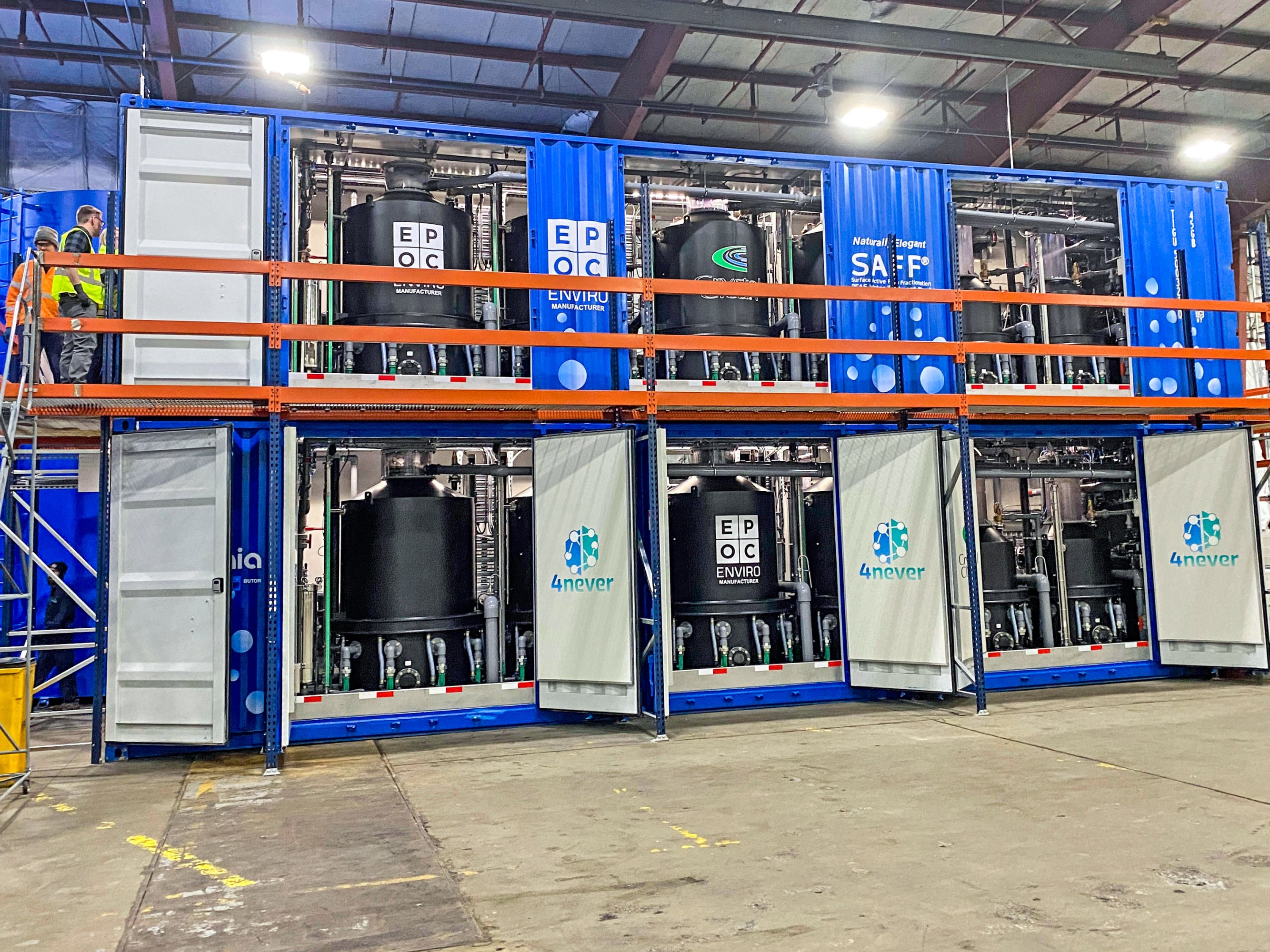
The quest to reduce the amount of PFAS in the environment is what led me to an industrial park in a southern suburb of Grand Rapids, Michigan. The jar of PFAS concentrate in my hand is part of a demonstration arranged by my hosts, Revive Environmental, during a tour of the company’s PFAS destruction site, one of the first in the country to operate commercially and at scale. A few yards in front of me sits the company’s PFAS “Annihilator” in a white shipping container. 

The Annihilator represents just one of several technologies now vying to break down and destroy PFAS. These span the gamut from established processes like electrochemical oxidation and supercritical water oxidation to emerging techniques relying on ultraviolet light, plasma, ultrasound, or catalyst-driven thermal processes. Some are deployed in field tests. Other companies are actively running pilot programs, many with various divisions of the US Department of Defense and other government agencies. And many other technologies are still undergoing laboratory research.

There’s good reason for this. Not only are PFAS everywhere around us; they’re also in us. Humans can’t break down PFAS, and our bodies struggle to clear them from our systems. Studies suggest they’re in my blood and yours—the majority of Americans’, in fact—and they have been linked to increased risks of kidney and testicular cancer, decreased infant birthweights, and high blood pressure. And that’s only what we know about now: researchers continue to grapple with the full impacts of PFAS on human and environmental health. 

Revive’s Annihilator and other nascent destruction technologies show the first signs of promise that these “forever chemicals” can be removed from the environment permanently, limiting further human exposure and risk. But destroying PFAS is only one step in the full remediation process. Across the globe, researchers are developing new technologies and techniques to better understand, test, and track the chemicals—as well as identifying alternative materials—to eliminate PFAS for good. 

Breaking it down

PFAS traces back to the mid-20th century, when the chemical giant 3M invented PFOA (perfluorooctanoic acid) to prevent nonstick coatings from clumping during production. Eventually, 3M began selling the material to fellow chemical companies, including DuPont, which used the material for its then revolutionary coating, Teflon. Later other manufacturers, such as Chemours and Corteva, would develop and produce their own brands. The health impacts of PFAS and extent to which the chemicals had pervaded the environment wouldn’t be discovered until the early 2000s, when legal action against DuPont unearthed evidence that chemical companies knew some of the risks PFAS posed to human health yet intentionally dumped them into waterways and unprotected holding ponds, where they eventually made their way into drinking water and people. 

Though it has been years since the initial hazards of PFAS were made public, scientists and regulators have since struggled with how best to remediate the contamination and keep people safe. Traditionally, PFAS are treated through standard water filtration methods: granular activated carbon, reverse osmosis, ion exchange resins. These methods work extraordinarily well to capture PFAS. The problem is, though, that once captured, the chemicals don’t go away. The filters are discarded or chemically washed for reuse, and the notoriously clingy PFAS reenter the environment through landfills and wastewater. Incineration—another traditional mitigation technique—risks sending undestroyed PFAS compounds up the smokestack and into the air. All the while, PFAS continue to be manufactured, used, discarded, and circulated through the environment. And so the hunt is on for a way to make the forever chemicals a bit more ephemeral.

For the Annihilator, Revive uses a destruction method called supercritical water oxidation (SCWO) to cleave the durable carbon fluorine bonds that characterize PFAS compounds. In another shipping container, which serves as the monitoring station for the Annihilator, David Trueba points to a bank of computer monitors displaying data from the various sensors inside the destruction device. Trueba is the president and CEO of Revive and serves as one of my guides on the tour. SCWO is essentially a PFAS pressure cooker, he explains, heating and compressing the contaminated liquid to a supercritical state of above 500 °C and 3,200 PSI. In that state, where water is caught in a sort of purgatory between liquid and gas, oxygen becomes soluble, and the resulting oxidation drives the reaction that ultimately destroys the PFAS. Among other applications, SCWO has been used to decommission and destroy old stockpiles of mustard gas, the brutal chemical weapon that plagued the trenches of World War I. Battelle, a national research nonprofit, adapted SCWO to target PFAS and spun off Revive as a private entity with investment from Viking Global Investors in January 2023. 

foam from a firefighter's extinguisher spraying toward the camera
The DoD is funding research into alternative firefighting foams that meet military standards.

After the PFAS is destroyed, the solution undergoes several post-treatment procedures. Then it’s cooled and pumped into plastic totes for storage and eventual discharge to the local wastewater treatment plant. The finished product is aqua blue, resembling water you might see at a Caribbean beach, and Trueba says it tests below Michigan’s maximum contaminant level standards for PFAS. 

Approaches and targets

Revive’s destruction operation targets PFAS in landfill leachate—a scientific term for what occurs when rainwater passes through landfill waste, absorbing chemicals and contaminants from the decomposing material along the way. Landfill leachate is one of the primary sources of PFAS contamination, which is unsurprising since that’s where many PFAS-laden products end up. 

Earlier in the tour we’d walked to an adjacent facility where a pair of workers, clad in heavy jumpsuits, hard hats, and boots, manned a hose running from the back of a polished-steel semi-trailer. The workers were pumping leachate trucked from a nearby landfill by Heritage-Crystal Clean, an environmental services company that’s partnered with Revive. The smell was about what you’d expect from a brown, sludgy cocktail of decomposition. 

“It’s the smell of money,” Trueba said. Later, he told me: “Innovation, in my mind, is not just an idea, but it’s getting paid for it. It’s getting the value in the market because the market values that it’s being adopted.” 

That may sound a bit brutally capitalistic for a widespread societal issue like PFAS, yet experts point to the very real-world issues of cost facing the companies and municipalities footing the bill for PFAS destruction. As much as there’s a race to destroy PFAS, there’s also a race to do it as cost-effectively and efficiently as possible. And Revive, with its brand of SCWO technology, isn’t the only one running the track.

“It’s important that this problem isn’t a tens or hundreds of trillion dollars problem. It needs to be kept to, like, a multibillion-dollar problem,” says Daniel Cho, founder and CEO of Onvector, a water treatment company using plasma technology to destroy PFAS. 

Video of Onvector’s technology shows a bright-blue flickering light, similar to a welding arc, accompanied by a high-pitched screech. During our conversation, Cho refers to the technology as “lightning and fire reliably delivered inside a flowing cyclone of water.” It’s a catchy phrase, meant to contain several PhDs’ worth of science in a neat, memorable package. In reality, the technicalities are more complex. 

Onvector’s technology combines the actions of a centrifugal separator with an electrode that ionizes gas injected into the device. The resulting reaction creates high-energy electrons that attack and break down the PFAS compounds. The system is currently deployed at Joint Base Cape Cod in Massachusetts and was partially supported through grant funding from AFWERX, the skunkworks division of the US Air Force. Cho expects to fully scale Onvector in 2024, he says. 

Another promising PFAS destruction technology is under development by Washington-based Aquagga. The company uses a method known as HALT (hydrothermal alkaline treatment), a sort of cousin to the SCWO process used by Revive. HALT also relies on pressure and heat to destroy PFAS, but it introduces sodium hydroxide as a catalyst before treatment. This allows PFAS to be treated at much lower temperatures than SCWO, says Brian Pinkard, Aquagga’s cofounder and chief technology officer.

Like SCWO, the technology was first developed to treat stockpiles of chemical weapons. Researchers from the Colorado School of Mines adapted it to destroy PFAS and licensed Aquagga to deploy it commercially. Pinkard was exposed to the foundations of HALT technology while working on his doctorate at the University of Washington, which involved decommissioning stockpiles of deadly nerve agents like sarin and VX gas. He views PFAS destruction and chemical weapons destruction as similar “problem sets.” 

“You have this toxic waste. Nobody wants to transport it. Nobody wants to burn it,” Pinkard says. “Everyone wants to have a system they can bring on-site, plug it into a barrel or tote, process the waste on-site, and turn it into nontoxic byproducts.” 

While these and other emerging destruction technologies show promise, there’s no single solution to eliminate PFAS from the environment, and each technology presents its own challenges. SCWO struggles with high concentrations of salt and requires pretreatment to remove it. The process also yields hydrofluoric acid, which Revive must neutralize before the cleaned liquid can reenter the municipal water system. HALT requires its sodium hydroxide catalyst to function, while plasma has yet to prove cost-effective at scale. Meanwhile, other companies are developing methods of treating PFAS in solid matter.

Then there’s the matter of which specific PFAS chemicals are actually being destroyed. Numbers vary widely, but experts estimate that between 6,000 and 15,000 separate PFAS compounds exist. Destruction technologies are effective at eliminating some of them, like the PFOS and PFOA subgroups widely used in industrial and consumer applications. However, these compounds also happen to be the most widely understood and regulated by state environmental agencies. Thousands more are understudied and undertested, and the jury is still out on whether existing destruction technologies can eliminate them. Even foam fractionation, a popular and efficient method for separating and concentrating PFAS prior to destruction, struggles to collect PFAS compounds that aren’t as susceptible to foaming.

A worker driving a forklift of containers into a shipping container
""

A worker loads PFAS-contaminated leachate into the PFAS Annihilator.

These uncertainties fuel a good deal of conjecture and jockeying among PFAS destruction companies. Access to a substantial untapped market is on the line, and some companies are quick to hold up their own technologies as the end game. The reality is, though, it will likely take a range of mature technologies, each deployed in situations matching their strengths, to solve the problem. 

“Bottom line is that the way that we approach treatment will be very site dependent, and we think that it is best to have several options,” a senior US Defense Department official said in an interview with MIT Technology Review.           

The DoD is one of the primary drivers of research on PFAS destruction, having funded, in some way, many of the technologies being used today. Much of the work the DoD has supported is aimed at contamination around military installations. For years, the US military sprayed a material known as aqueous film forming foam (AFFF) to put out fires, whether in training or in real-world situations. AFFF is chock-full of some of the most harmful PFAS compounds, and the DoD has since spent substantial money and effort trying to remediate the resulting pollution. 

The DoD agencies that conduct environmental R&D and validation have funded $160 million worth of PFAS destruction and related projects alone since taking up the charge in 2009, according to the department official. Outside the DoD, the Biden administration also recently made the issue a key priority, allocating $5 billion from its 2023 Bipartisan Infrastructure Law to address PFAS contamination.

Decades of proliferation

Despite the progress on destruction technologies, the physical (or chemical) act of destroying PFAS represents only a fraction of the work required to rid the environment of these compounds for good. Repurposing the traditional remediation technologies and techniques used to treat major contaminants like chlorinated hydrocarbons (including PCBs), pesticides (including DDT), and lead simply won’t cut it with PFAS, says Philip Simon, founder and president of Ann Arbor Technical Services, an environmental consulting firm based in Michigan. PFAS, in many cases, require a rewrite of the remediation playbook. 

“You’ve got a lot of compounds used very broadly in commerce in an unregulated setting for 70 years,” Simon says. “That never happened with PCBs—never. That didn’t happen with chlorinated pesticides. So if you think that DDT and chlorinated pesticides, and then later PCBs, foreshadow what we’re up against here, forget it. It’s way more complicated than that.”

While the PFAS playbook is still being written, part of the work involves new methods of environmental forensics, a field essentially amounting to chemical detective work. PFAS—and other contaminants—all have their own chemical fingerprints, says Simon. Manufacturers use slightly different chemistries and processes when creating the compounds. These differences, and the impurities introduced along the way, give PFAS unique signatures that forensics experts can trace back to the source. This type of intelligence provides a more accurate picture of the specific types of PFAS present at a contamination site, making more targeted treatments possible. Going forward, forensics is also likely to play a pivotal role in determining which parties are responsible for releasing PFAS and should therefore fund remediation efforts, Simon says. 

The DoD began funding forensics projects related to PFAS in 2020 and has since supported projects including creating a forensic library of PFAS compounds, developing mobile labs for rapid PFAS analysis, and using machine-learning models for PFAS recognition and analysis. 

Even more important than eliminating the PFAS already in the environment is ensuring that they’re no longer used, or even made, in the first place. There’s been substantial progress in this area: with the cloud of national-scale PFAS regulation looming and customers becoming increasingly aware of the potential health risks, more companies are diving into their supply chains to find where the PFAS are and how to source replacements, says Shari Franjevic, program manager at GreenScreen for Safer Chemicals, which provides certifications for products free of PFAS and other harmful substances. GreenScreen’s website lists around 150 products the organization has deemed safe, including chemicals for textile manufacturing, cleaning, food service, and firefighting. The DoD is also funding research into alternative firefighting foams that meet military standards, several of which show “promise,” according to the defense official. 

In many cases, compounds that were used before the widespread introduction of PFAS still offer viable and safer alternatives, Franjevic says, citing the natural waxes once common in dental floss and food packaging. 

“I think that when people think about alternatives, they make the assumption that new chemistry must be invented or found,” Franjevic says. “And in most cases, it’s just not true, because there are historical products that used other chemistries.” 

Major chemical manufacturers have also begun yielding to mounting pressure to cease PFAS production and answer for their roles, and often their complacency, in PFAS contamination. In mid-2023, 3M agreed to a $10.3 billion settlement to fund remediation of PFAS in public water for the next 13 years. The settlement comes on the heels of 3M’s announcement in late 2022 that it would stop all production of PFAS by 2025. Other major PFAS manufacturers, including DuPont, Chemours, and Corteva, agreed to a nearly $1.2 billion settlement regarding their roles in PFAS production and contamination in mid-2022.    

Weaning both industry and consumers off PFAS is proving an uphill battle, though. Like chemical vigilantes, these compounds may leave a mess in their wake, but it’s hard to dispute their effectiveness. While 3M may plan to stop production, numerous other chemical companies across the globe still manufacture PFAS, and the willingness to adopt alternatives varies by industry. 

“That notion of peak PFAS, I think, is still very, very elusive,” Cho of Onvector says. “We have to control how we make it or [determine] what the essential uses are.” 

In food packaging, for example, PFAS are typically used as a grease or liquid barrier on products including pizza boxes, drinking straws, and disposable coffee cups. While PFAS-free food packaging exists in the market, most doesn’t live up to the performance or cost standards demanded by industry, says Keith Vorst, director of the Polymer and Food Protection Consortium and associate professor in the Department of Food Science and Human Nutrition at Iowa State University. “I don’t know that the brand owners are willing to give up performance,” Vorst says. “There’s too much fear.” 

Iowa State scientists, including Vorst and his colleague Greg Curtzwiler, are experimenting with embedding polymers and binding agents into agricultural byproducts like coffee grounds and cassava root to create packaging without “intentionally-added PFAS,” Vorst says. 

The phrase“intentionally-added” underscores just how prickly the PFAS problem is. Because the compounds are so widespread in the environment, a product may inadvertently take them up through the materials, including water, used to produce it, Vorst says. He notes that products containing recycled and recovered materials are particularly susceptible to PFAS exposure because those recycled materials, like paper, may already be contaminated.                

The complexity and pervasiveness of PFAS make remediation overwhelmingly difficult, though progress is being made. Vast amounts of time and resources have been dedicated to understanding the compounds’ chemical personalities, their vulnerabilities, and their implications for the environment and human health. But the progress that has been made has come from people and groups battling significant headwinds: environmental indifference, political skittishness, and industry obfuscation. The sense among those I interviewed suggests that all this work is now coalescing, just waiting for a nudge over the edge to really gain momentum and enact lasting change. Many believe that nudge will come in the form of federal regulation.

In March 2023, the US Environmental Protection Agency proposed national drinking water standards for six PFAS compounds as part of the agency’s PFAS Strategic Roadmap. These standards amount to suggestions at this point, but industry insiders expect regulations regarding PFAS contamination in water, soil, and other parts of the environment to be adopted by the end of 2024. The European Union is also exploring sweeping restrictions on the manufacture and use of PFAS. In Australia, New South Wales and South Australia have both banned the use of PFAS-laden firefighting foams, and the Australian government’s Department of Climate Change, Energy, the Environment, and Water is developing a national PFAS management plan. Once regulations take effect, everyone from private landfill owners and municipalities to manufacturers will be compelled to examine their role in handling PFAS and make investments to remove the compounds from their process or destroy them altogether. 

In the US, however, in the absence of strict federal guidelines, PFAS regulation has thus far been left in the hands of individual states. “The states are acting on their own timeline. Some of them are waiting to see what the federal government does. Some are moving faster,” says Pinkard of Aquagga. “It’s all happening in real time. It’s changed a lot even in the last year.” Some states, like Michigan, Maine, and Wisconsin, have developed enforceable drinking-water standards. But many others have stopped far short of enforceable regulations, with some doing nothing at all to regulate PFAS. 

“People aren’t going to treat water beyond what they’re regulatorily required,” Cho says. He also notes that “the lack of nationally harmonized regulations on PFAS has been a major obstacle toward the evolution in this [PFAS destruction] space.” 

Ultimately, the degree to which PFAS is removed from the environment will come down to the collective will of regulators, industry, and society at large. While policymakers inch closer to regulation and private industry sweats it out over liability and risk, researchers developing destruction technologies plan to continue demonstrating that even forever chemicals are far from invincible. 

John Wiegand is a freelance journalist based in Michigan.

Wednesday, October 25, 2023

What the U.S. Has Argued in the Google Antitrust Trial

October 25, 2023 0
What the U.S. Has Argued in the Google Antitrust Trial
https://ift.tt/eRYJcOy
As the government wraps up its case in the landmark monopoly trial, it has built a picture of how Google became dominant in online search — and the harms that it says resulted.

from NYT > Technology https://ift.tt/47kTqtW
via IFTTT

Job titles of the future: carbon accountant

October 25, 2023 0

via MIT Technology Review https://ift.tt/Fb2VGgk

His official title is vice president of regulated reporting solutions. But really, Billy Scherba is a carbon accountant. At Personifi, a platform for climate management, Scherba works with companies to measure, manage, and disclose their contributions to climate change.

Carbon accountants help companies understand what data matters to their carbon footprint, how to collect that data in a consistent manner, and how to use it to calculate the greenhouse-gas emissions they’re responsible for. Many times, that means working with clients to upgrade their data infrastructure so it’s easier to see what parts of their operations emit the most. 

Billy Scherba
COURTESY PHOTO

A growing field 

A relatively new occupation, carbon accounting involves collecting a wide variety of data from an organization and using consistent measurement techniques to translate that data into a carbon emissions footprint. The calculations can be based on specific organizational activities such as business flights, kilowatt-hours from a utility bill, the kinds of fuel used to transport products, or even financial data. As organizations collect and analyze more granular data, their calculations get more precise. 

Notes on methodology

The Greenhouse Gas Protocol (GHGP), developed by the World Resources Institute and the World Business Council for Sustainable Development, is the primary methodology used for carbon accounting and is available publicly at no cost. Other, specialized carbon accounting standards do exist, but regulators from the US Securities and Exchange Commission, the European Union, Japan, and others have incorporated the GHGP into their rulings, making it the go-to accounting method for organizations publicly disclosing their carbon emissions. 

Measure. Report. Decarbonize.

Business leaders need data they can understand that highlights where their firms are having the most significant positive and negative climate impact. “Good data should be used to drive business and societal value,” says Scherba. “As we build controls and ensure this data is reliable, we have an opportunity to use it to make better climate decisions.”